Tales from Baker’s Flat, II

A cautionary tale from the South Australian Supreme Court criminal sittings, reported in the South Australian Register of Saturday 12 May 1866 under the headline Burglary.

In summary – a man called John Lenane was charged with stealing 16 shillings from the dwelling of Mary Anne Russell at Baker’s Flat.

The report describes her house as ‘consisting of but one small room, and composed of bags and a little mud’.  Mary Anne Russell was a widow, living with her three children, and ‘on Sunday evening, …  she sought the repose of her pillow “to dream she dwelt in marble halls” when her slumbers were disturbed by the sudden intrusion of the prisoner through the back part of the premises. Having thus burglariously entered her dwelling he abstracted from her box the amount he was charged with having stolen’.

Mary Anne Russell explained how she had gone to bed at 10pm, having bolted the door, but woke at 11pm, when she ‘saw the prisoner entering the back of the room by tearing down the bags. He had a hammer in his hand, and he at once went to her box and took out of it the 16s, which was wrapped in a piece of paper’. She did not speak to him, but as soon as he’d left, she got a light and checked what she had lost.

According to the newspaper report, the prisoner was her nearest neighbour, and had given her permission to live in the hut. ‘It was on land occupied by him, and was formerly, she believed, a cow-house. She repaired it with some bags and mud to make it habitable for herself and her three children. The light was admitted through the doorway’.

Three witnesses were called for the defence. Michael Gould stated that Mrs Russell was at his house until 11pm on that evening. He also stated that he had known John Lenane for years, and that his character was very good. Jane Gould, Michael’s wife, also stated that Mrs Russell was at her house at the time when the robbery was said to have been committed. Another witness, Ellen Flannary, gave similar evidence.

The judge ‘did not think it necessary to proceed further in the case, inasmuch as it was evidently impossible for [Mrs Russell] to identify the prisoner in the darkness of her room and at a late hour of night. The Jury under direction acquitted the prisoner’.

Aside from introducing an adverb I have never seen before – burglariously – there are a number of other interesting features of this story:

  • The reference to the song ‘I dreamt that I dwelt in marble halls’ – which was from a popular opera called The Bohemian Girl by Irish composer Michael W Balfe, first performed in 1843 in London. It remained popular throughout the nineteenth century both in England and abroad
  • Mary Anne Russell’s living conditions, which appear fairly grim. She had renovated a cow shed with bags and mud, and there was no natural light except through the doorway
  • The significance of community relationships – the testimony of Michael Gould, Jane Gould and Ellen Flannary all favoured the defendant, John Lenane. It appears that there were no witnesses for Mary Anne Russell. Perhaps the defendant had greater access to legal services, or had more resources at his disposal
  • Mary Anne’s vulnerability – a woman, widowed, responsible for three children, and living in what was still essentially a cow shed. A man with a hammer could easily tear down the walls and break in
  • The unknowns – the newspaper report presents the facts of the court case, but we are still unaware of the full circumstances of the incident. Was John Lenane taking advantage of a vulnerable woman? Was he trying to retrieve rent that he was owed? Was there bad feeling between them? If it wasn’t John Lenane, who else could it have been? The case centred on the timing – if Mary Anne Russell was just guessing the time as 11pm, perhaps everything else was true, and she was stymied by the lack of a clock
Posted in Baker's Flat, Kapunda | Tagged , , , , | 2 Comments

Tales from Baker’s Flat, I

Searching through old newspapers on the National Library of Australia’s Trove, I’ve found a number of stories, some comical, some sad, relating to the residents of Baker’s Flat.

A story from August 1868 is headlined as A Midnight Adventure. It concerns two characters, Mr and Mrs JP Moyle of Kapunda, sleeping peacefully on a Saturday night. And one rather drunk man from Baker’s Flat.

It appears that Mr Moyle was woken in the early hours by a noise in the kitchen. On investigating, he found our drunk Baker’s Flat resident surveying the kitchen by candlelight. After questioning the intruder, who told him he’d been there for two hours, Mr Moyle shoved him out the door and went back to bed.

And then, as the newspaper reported:

‘On Sunday morning Mrs Moyle went to the safe to look up the eatables wherewith to garnish the breakfast-table, when lo! many of the viands were rendered conspicuous by their absence; a nice piece of spare rib of home-fed pork, weighing about four pounds, was looked for in vain, until at length a solution as to the manner of its disappearance was furnished by sundry bones being found on the floor. It was at once apparent that the nocturnal visitor had been looking after the victualling department during the two hours’ sojourn in the land of plenty, and had demolished the joint of pork by way of an early breakfast; half a large cake had been similarly disposed of and butter had been woefully decreased, in quality as well as quantity, for, no knife being at hand, the hungry guest had mauled out the necessary garnishing of butter with his open hand, the traces of his dirty fingers being plainly visible in the unconsumed portion. Actuated, doubtless, by a desire to be up betimes on the following morning, the solids had been washed down by a bottle of yeast which had been left in the safe. During the course of Sunday Mr Moyle met his visitor and wife, the latter of whom was complaining that they were nearly starving – the truth of which assertion, however, Mr Moyle disputed, so far as the head of the family was concerned, remarking that he, at all events, had laid in stock to last for some considerable time. The man, however, had quite forgotten the incident. It was extremely fortunate for him that he had made his way into a house where he was known, or his faculty for constituting himself a temporary member of the family might have led to his domestication in one of Her Majesty’s establishments where the hours kept are regular, the work constant and the diet light.’

The full story is available in the South Australian Register of 31 August 1868.

Posted in Baker's Flat, Kapunda | Tagged , , | 6 Comments

Fido, what have you done with your tag?

Most recently, I’ve been cataloguing and photographing dog registration tags. OK, that’s a bit of a conversation stopper. But bear with me, and read on …

The Dog Act of 1860 divided South Australia into districts, and compelled all dog owners to register their dogs annually. In 1867, the revised Dog Act introduced an annual registration fee of five shillings, as well as the requirement to fit a collar to the dog, stamped with the registration and district numbers.

The Dog Act Amendment Act of 1884 increased the registration fee to seven shillings and six pence. It also introduced the metal disc, a visual improvement on the stamped collar. The metal disc varied each year in size, shape and colour, and was inscribed with the year, registration number and district of the dog registered.

So … by 1884, you had to pay 7s 6d to register your dog, and have it wear a tag. And it appears that the dog owners of Baker’s Flat were determined to toe the line. The photo below shows what appears to be a bullet hole in an 1885-1886 dog tag – the original punched hole (which usually held an attachment rivet) is broken; perhaps the dog owner was so keen to have that tag on the collar that he shot it to create a new hole.

1885-1886 dog tag, with possible bullet hole

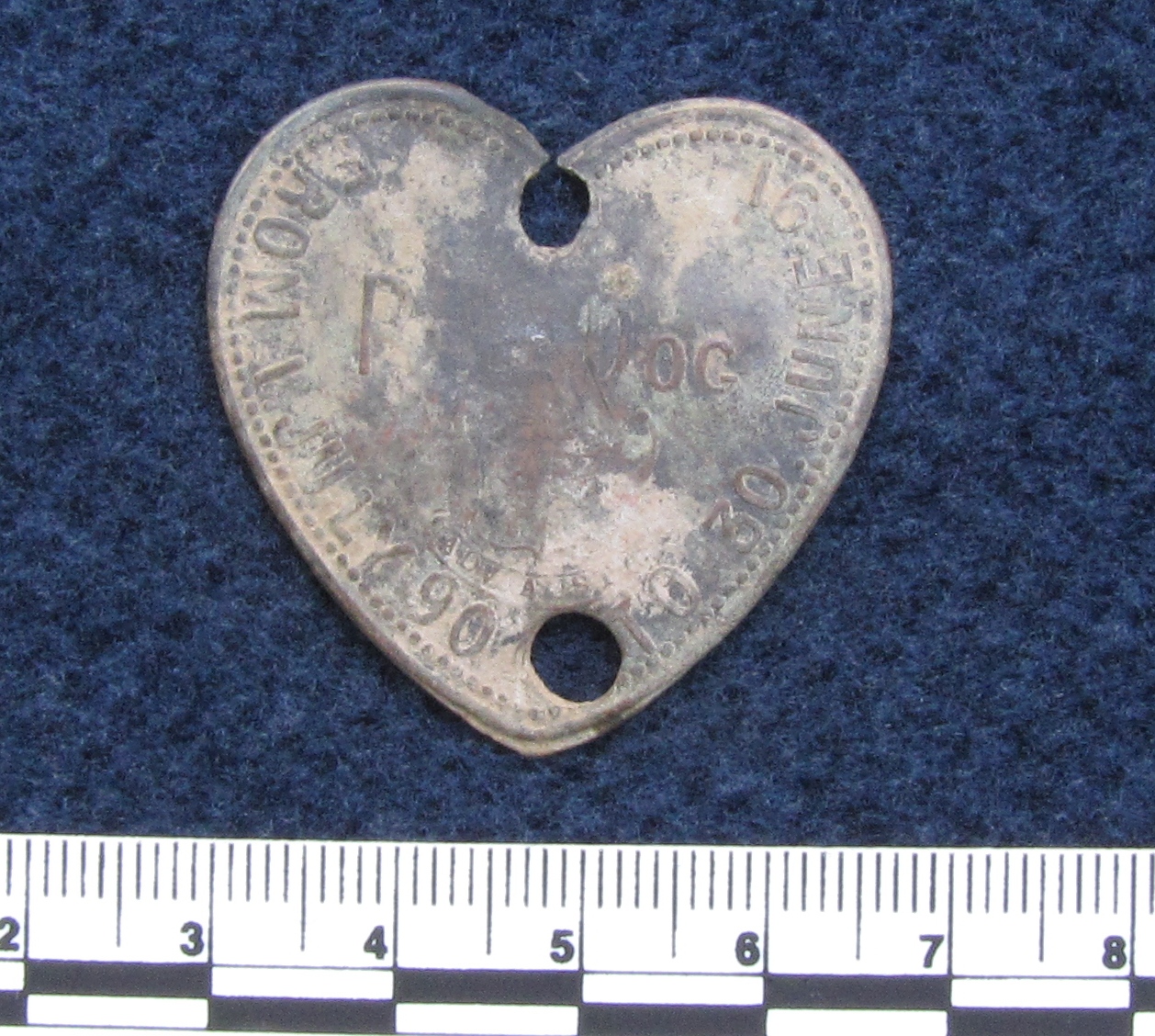
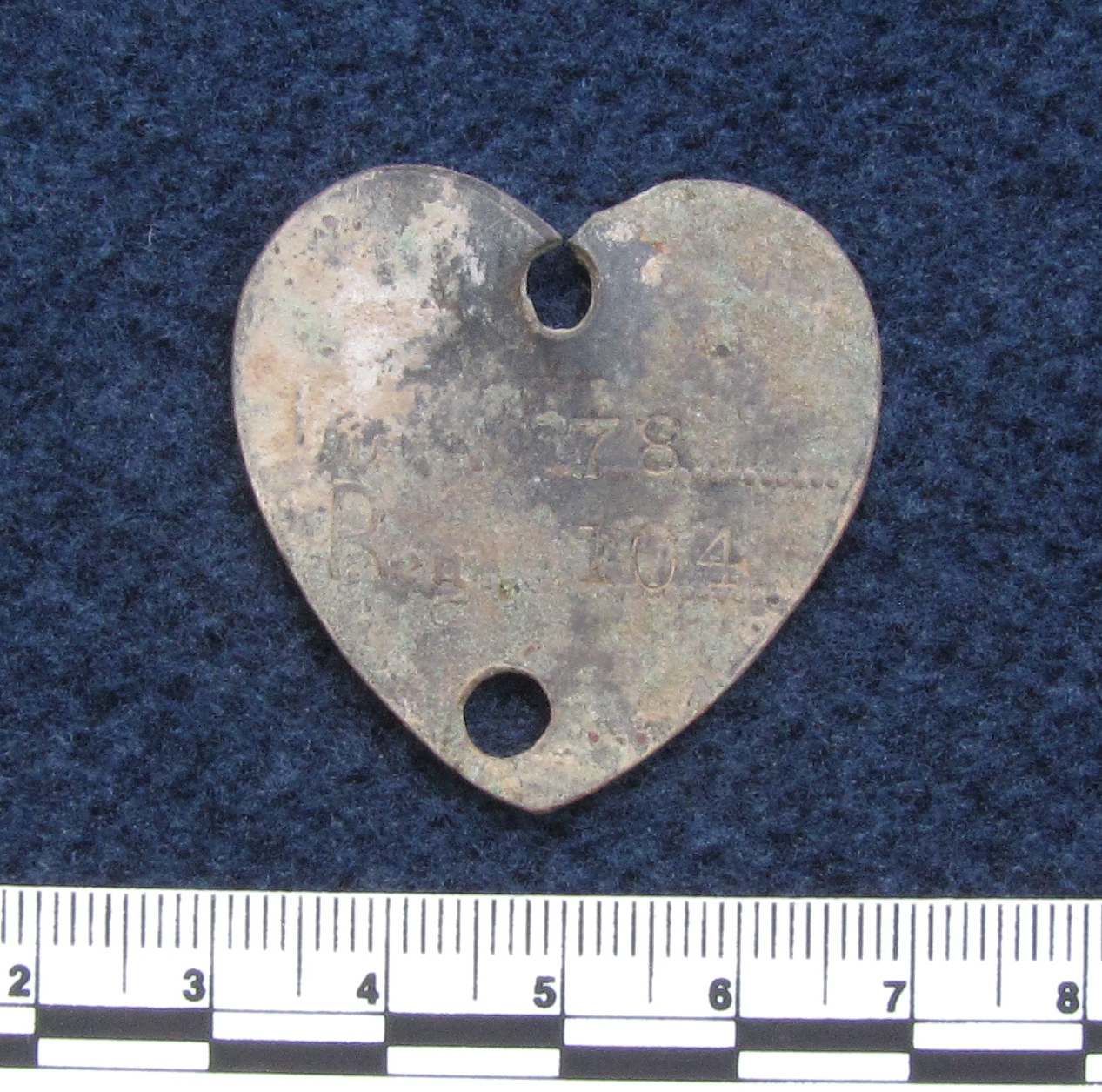
The tag below, for 1890-1891, is heart-shaped. The attachment rivet is missing, and there’s another hole near the base, although this one doesn’t look like a bullet hole. The face has embossed dots all the way round. The back is plain and worn, but it’s still possible to make out the registration number 104 and the district 78.

Heart-shaped dog tag for 1890-1891

Heart-shaped dog tag for 1890-1891

Heart-shaped dog tag stamped with registration 104 and district 78

Heart-shaped dog tag stamped with registration 104 and district 78

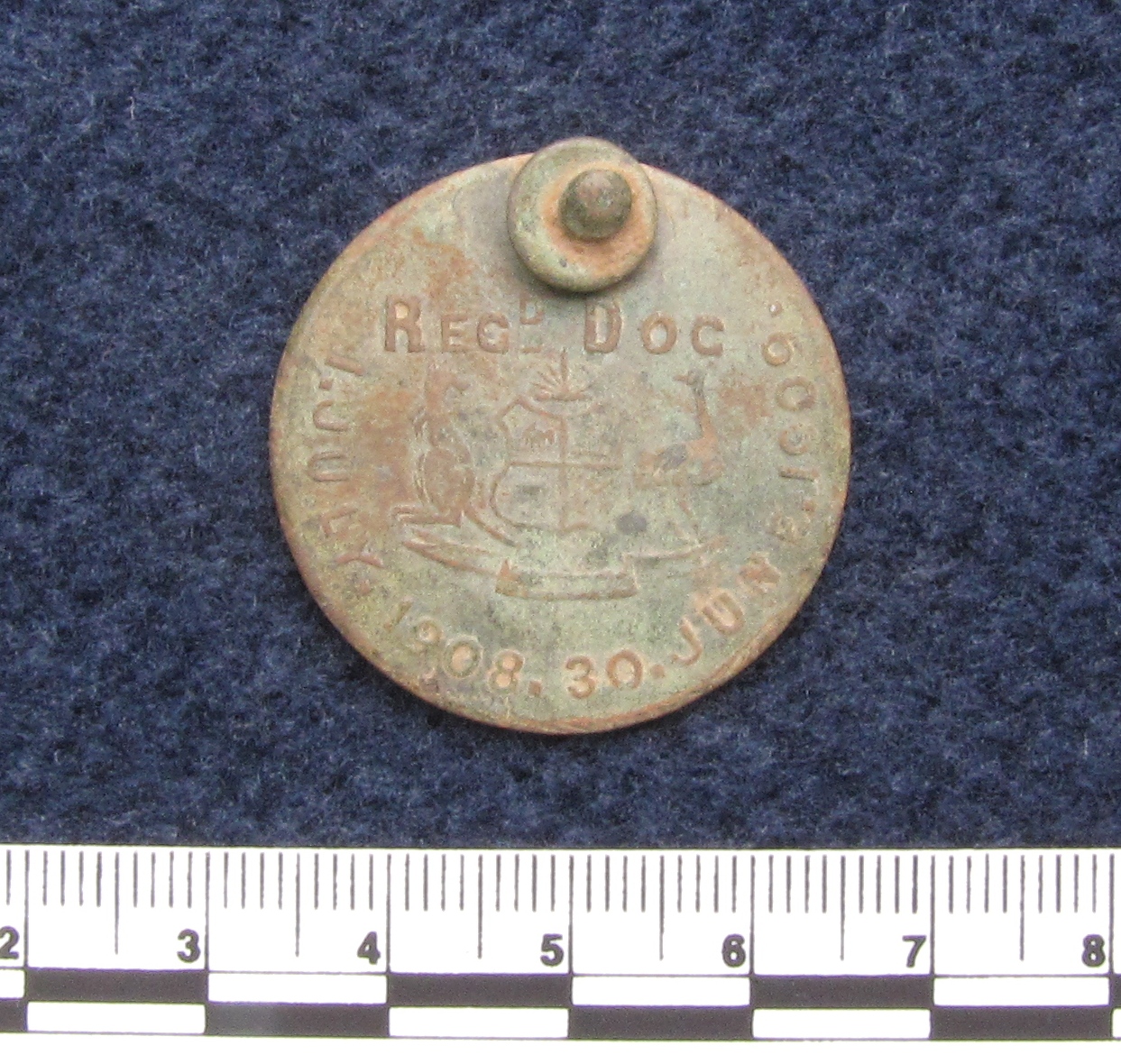
The 1908-1909 tag below is circular and retains its rivet. On the face, you can see that it’s stamped ‘Regd Dog’, has an Australian coat of arms featuring the kangaroo and emu, and the date 1 July 1908 30 June 1909. On the back, the registration number is stamped 28 and the district 78.

Circular dog tag for 1908-1909

Circular dog tag for 1908-1909

Circular dog tag stamped with registration number 28 and district 78

Circular dog tag stamped with registration number 28 and district 78

So, you can see, there’s a lot of information on a dog tag. And from that, I should be able to track down who registered the dog. The Registrar of Dogs recorded the dog owner’s name; the number of dogs they kept and where; the dog’s name, sex and age; the dog’s colour; and the breed. These were recorded alphabetically in dog registers. This means I can find a lot more information about life and dogs on Baker’s Flat.

And some of the questions this raises for me? From research so far, it seems that the people living on Baker’s Flat did not pay rent. In fact, they actively avoided paying rent – seeing off rent collectors and unlucky surveyors by throwing them in the river or pelting them with eggs. But the 150 or so dog tags found on the site indicated that they registered their dogs – this is a very law abiding activity. Certainly, the penalty for an unregistered dog was significant – a dog owner whose dog was found without a tag could be liable to forfeit the dog and pay a fine of at least five shillings and up to forty shillings. Perhaps there was a very diligent dog inspector at work in the area, more determined than the egg-covered rent collectors?

Posted in Baker's Flat, Cataloguing | Tagged , , , | 22 Comments

Hi ho, hi ho, it’s off to catalogue I go …

Being a trained librarian, I have to admit to a certain excitement when faced with the prospect of cataloguing. Don’t judge me! But do think about this – if you collect lots of data but it doesn’t generate any useful information, it’s a waste of time. And none of us have that much time to waste. Way back in the day, this was our mantra – Garbage In, Garbage Out.

So, I’ve scoured guidelines from Heritage Victoria and Flinders University Archaeology Department. I’ve read volumes of excavation reports to see how they’ve divided artefact sets by type and function. I’ve used what others have done; there’s not a lot of point in inventing a completely new system that is not compatible with any other data collection. And now I’ve carefully crafted a draft Excel spreadsheet to test my categories.

I’m in the fortunate position of having access to an existing collection of metal artefacts from the Baker’s Flat site. This collection is located about 80km north of Adelaide. On Sunday, after waiting for the fog to lift, I headed north, past the salt pans, into the green, Christy Moore belting out at top volume to get in the mood.

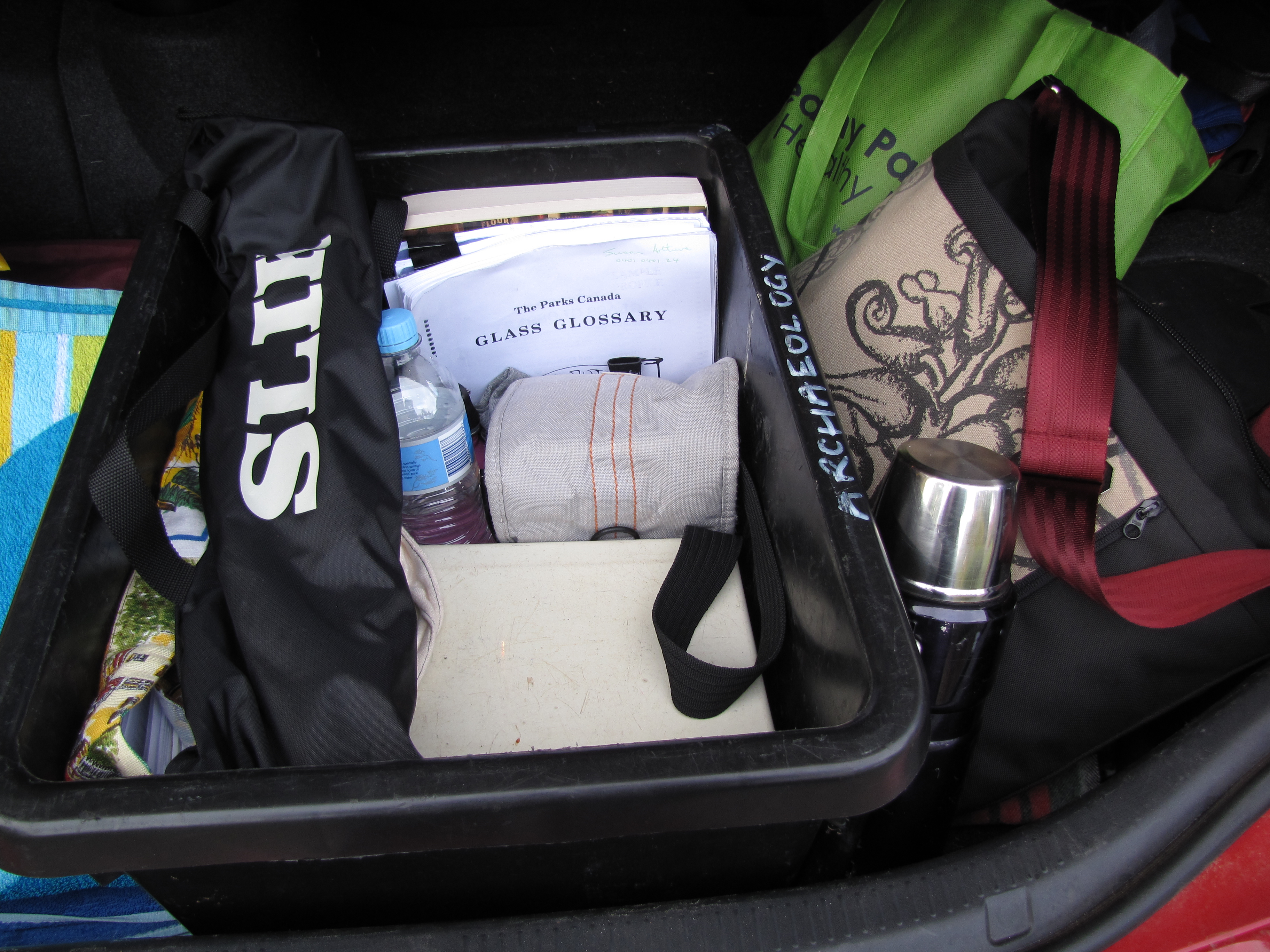
Cataloguing essentials

Cataloguing essentials

In the back of the car, I had:

  • Camera equipment – camera, new shiny tripod, photo recording form, photo scale, attractive blue fleecy material to use as backdrop
  • Computer equipment – laptop loaded with draft cataloguing spreadsheet, power cord, mouse
  • Precision vernier calipers – borrowed from good friend, having lost mine in a field somewhere
  • Digital weighing scales – borrowed from friendly archaeology department
  • Resource books – on glass, buttons, coins, nineteenth century shopping catalogues, etc. Really for reassurance, I know I’m not going to get too far on the first day
  • Background photos and information on Baker’s Flat – also for reassurance
  • Thermos of hot water and tea bags – Need. Lots. Of. Tea.

At the end of the day, I had photographed 30 dog registration tags, and catalogued 25. Only another 1500 artefacts or so to go!

Posted in Baker's Flat, Cataloguing | Tagged , , , | Comments Off on Hi ho, hi ho, it’s off to catalogue I go …

Remembering one’s shovel

Back after excavating for a week at St Johns near Kapunda. This site is being researched by a Flinders University PhD archaeology student, and is about five kilometres from my own research area of Baker’s Flat.

St Johns was one of the earliest Catholic parishes in South Australia, and was used first as a church and presbytery, then a school, and finally a girls’ reformatory. In the 1850s and early 1860s, the people on Baker’s Flat walked here to get Mass on Sundays. With a focus on landscape and gender archaeology, the research is centred around how the site evolved from a primarily male environment, to a place for community, and then to a female enclosed space. (De Leiuen 2013)

Fresh from this excavation, I thought I could make a few points about excavating in South Australia in April:

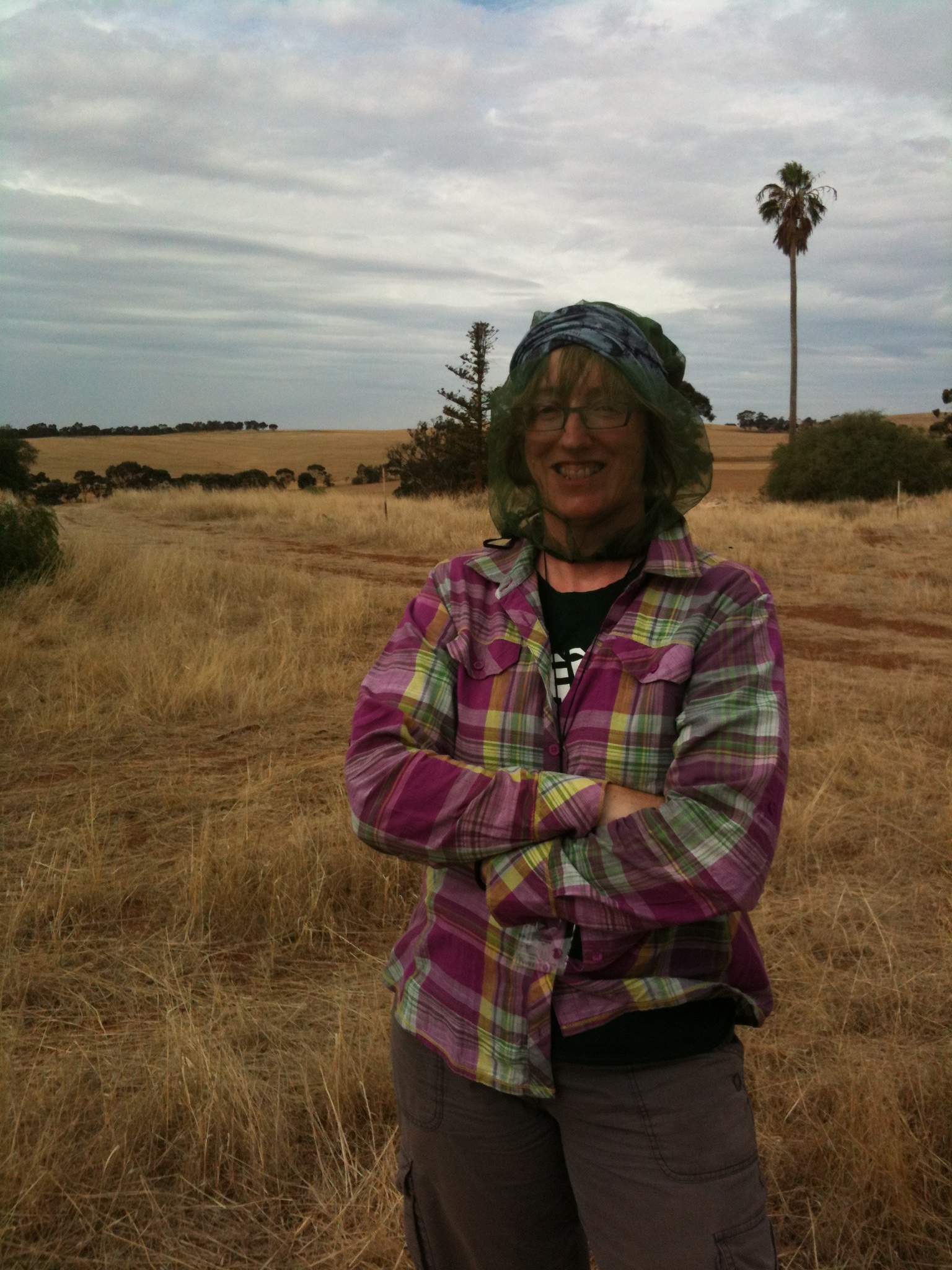
1. If all the adjoining fields have had their crops harvested and are now full of sheep, bring a fly net. There will be millions of flies, all desperate to explore your nose, ears and the back of your throat.

Essential field requirement - the fly net

Essential field requirement – the fly net

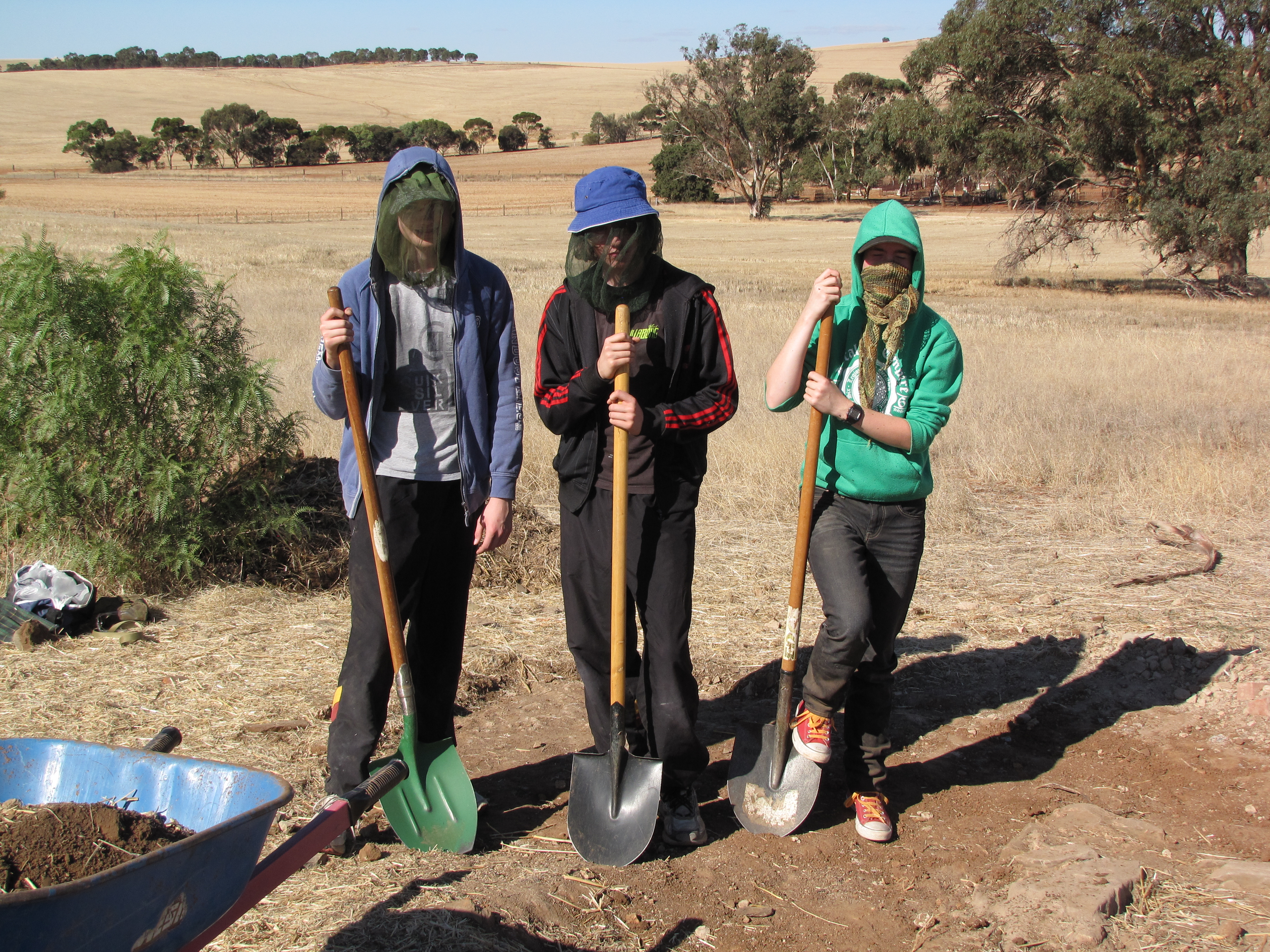
2. Being school holidays, you may have access to a (limited) supply of 15 year olds who will mattock, dig and sieve, provided they get paid in soft drink and crisps. Note judicious use of fly nets by said 15 year olds, who remembered their shovels.

Have shovels, will work

Have shovels, will work

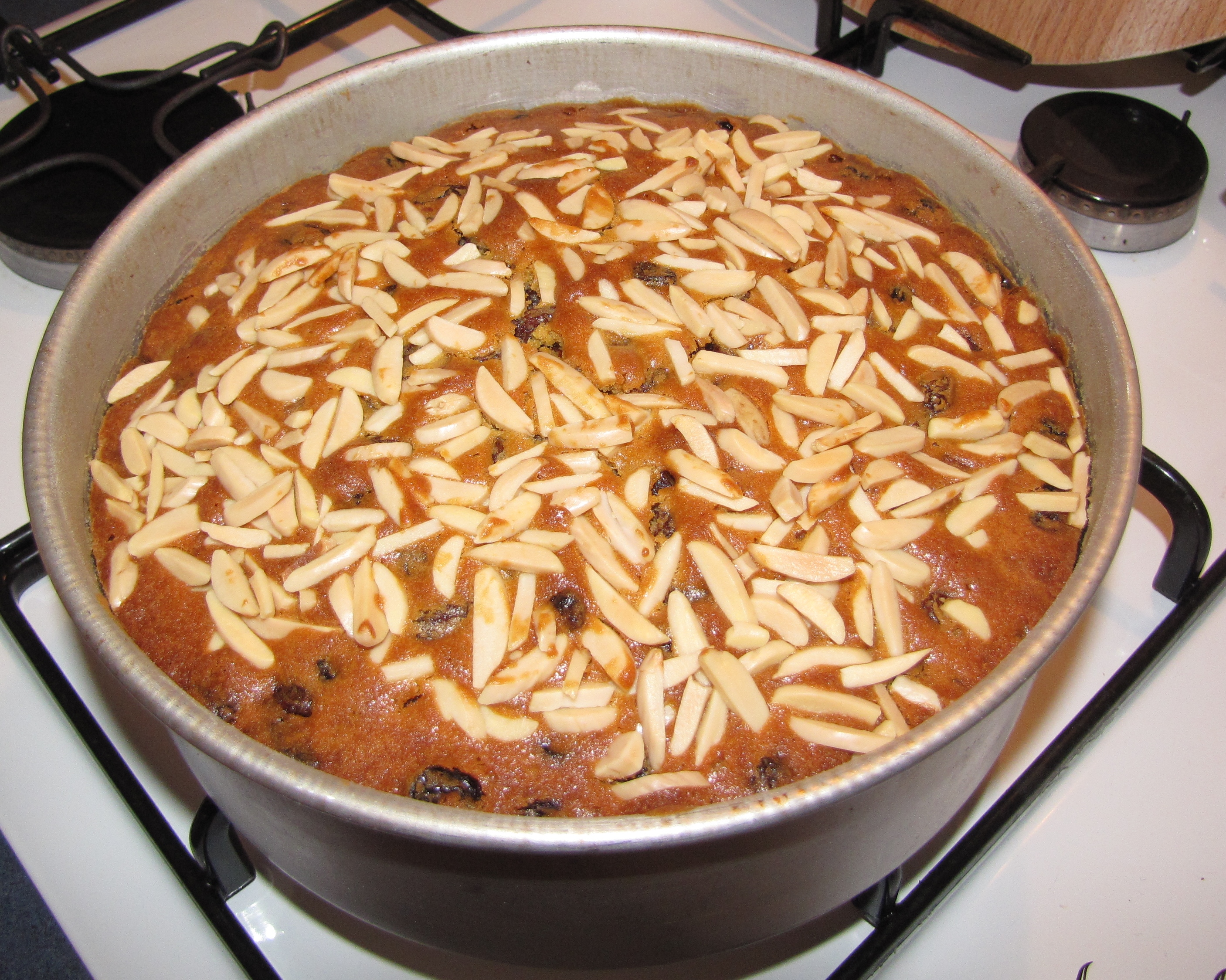
3. Home made fruit cake is low GI, and will enable you to work for hours on just one decent-sized piece. And it tastes better outdoors.

Fruit cake destined for the field

Fruit cake destined for the field

References:
De Leiuen, C. 2013 Research Design – St Johns, Kapunda. Unpublished report.

Posted in Baker's Flat, Excavation, Field work, Kapunda | Tagged , , , , | Comments Off on Remembering one’s shovel