Mystery metal man

The photo below shows the slightly rumpled bust of an unknown man. It was found on Baker’s Flat at some time in the last few years. It’s not very big, about 7 cm tall, and I’m assuming at this stage that it’s nineteenth century. Any takers for who it might be? After extensive research on Google images and the web (!), I’m thinking that it could be Gladstone, Prime Minister of Britain four times in the mid to late nineteenth century, and a supporter of Home Rule for Ireland.

Mystery metal man. Possibly Gladstone?

Mystery metal man. Possibly Gladstone?

The photo below is definitely Gladstone. This is a statue located in Manchester city centre. It’s a bit hard to get the same perspective, because the bust shown above was easy to photograph on a table, whereas the one below is on a plinth much taller than me, and the staute is bigger than lifesize. Hence, I get a good view up his nose! Both share the same hair, cravats and high collars. But these are common styles of the day, and I remain unsure if my mystery metal man is really Gladstone. Your thoughts?

William Ewart Gladstone - statue in Albert Square, Manchester

William Ewart Gladstone – statue in Albert Square, Manchester

Posted in Baker's Flat, Cataloguing, Travelling | Tagged , , , , , | Comments Off on Mystery metal man

Newgrange and the fairy teeth

Nothing about Newgrange is relevant to Baker’s Flat or my research. But it is one of my favourite places in Ireland, and I’ve been going there since I was a child. Dating from about 3,200 BC, it’s Ireland’s best known passage tomb.

When I announced that I was bringing all the children in the house to Newgrange to see their cultural heritage, my niece went ‘Great! I’d love to come. That’s the tomb with the fairy teeth’. Apparently, many children are told that when they lose their baby teeth and the tooth fairy takes them away, they end up at Newgrange as part of the quartz wall.

We all made a good inspection of the wall on our arrival, and whilst large (those baby teeth must be given some magic growth hormone on arrival), they do fit the myth. Between 1962 and 1975, the site was excavated by Michael O’Kelly, and the dental finds included 32 teeth (O’Kelly 1982:205). Maybe that tooth fairy has been busy for thousands of years building walls at Newgrange.

Newgrange

Newgrange

The kerbstone at the entrance to the tomb is highly decorated with spirals and lozenges, and sits in front of the doorway and roof-box. You can see the roof-box in the photo below above the ceiling flagstone. This is where a beam of sunlight shines through for five days each year at the winter solstice. At 8.58am on each of those mornings, a narrow beam of light penetrates the roof-box, hits the floor, and gradually extends to the rear of the chamber, illuminating the entire room. It lasts for 17 minutes each time.

Decorated entrance stone to Newgrange passage tomb

Decorated entrance stone to Newgrange passage tomb

References
O’Kelly, M. 1982 Newgrange: Archaeology, Art and Heritage. London: Thames and Hudson.

Posted in Around the world, Folklore | Tagged , , , , , | 3 Comments

Not every city has a sewerage museum

But Manchester does. It’s one of very few in the world, surprisingly. And it’s part of the Museum of Science and Industry, MOSI.

Did you know, for example, that until the nineteenth century, sewer lines were made from tree trunks? This is where the term ‘trunk line’ comes from.

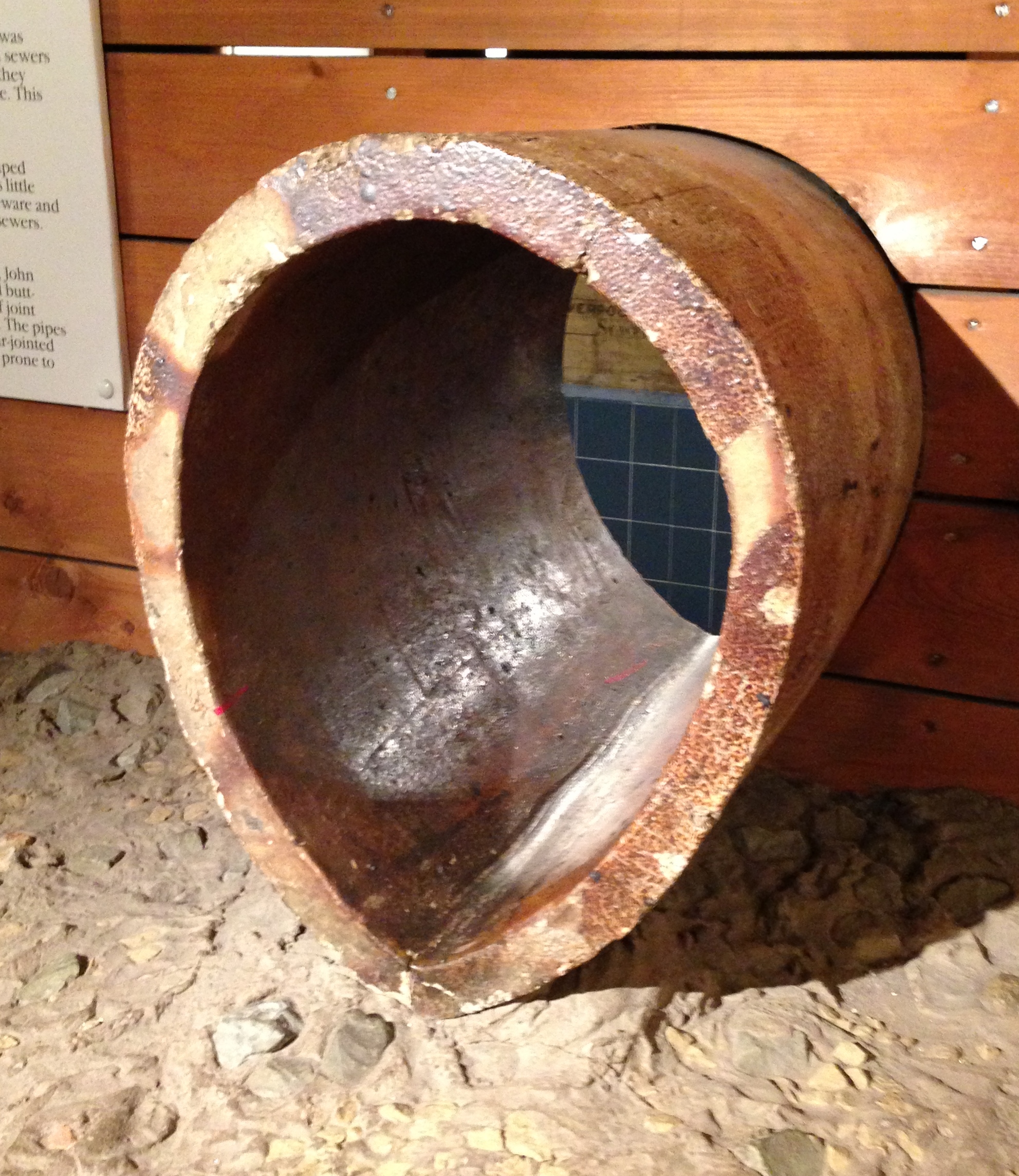
In the first half of the nineteenth century, Manchester built U-shaped sewers, like the one in the picture below at MOSI. Manchester was just about the only place to build them like this, but they were more efficient than flat bottomed sewers because they concentrated all the … ahem … sewage into the centre  – it made them self-cleaning.

U-shaped sewer, nineteenth century, Manchester

U-shaped sewer, nineteenth century, Manchester. At MOSI

Egg-shaped sewers worked just as well as U-shaped ones, but they were made of glazed stoneware and were cheaper and faster to install than brick sewers.

Egg-shaped sewer, nineteenth century, Manchester

Egg-shaped sewer, nineteenth century, Manchester. At MOSI

This man-entry sewer, which you can walk through –  was built using material from an 1830s Manchester sewer. It would have been egg-shaped originally, a false bottom has been added to make it easy to walk through.

Reconstruction of a Manchester sewer, MOSI

Reconstruction of a Manchester sewer, MOSI

It even has some stuffed rats crawling contentedly in a side drain. Did you know that sewer rats, which were common in the nineteenth century, could easily leave the sewers and go into houses in search of food? That’s a nice thought to leave with, isn’t it? Dirty great sewer rats, carrying disease and pestilence.

Spot the sewer rats in a side-drain

Spot the sewer rats in a side-drain

***Note: I am living in Manchester for three months until Christmas, so blog posts will have a northern hemisphere flavour for the next little while. Enjoy!

Posted in Museums | Tagged , , , , | 1 Comment

Something about Mary

In the collection of artefacts from Baker’s Flat, there are fourteen religious medals. Of these, eleven feature Mary, mother of Jesus. These include medals of the Sacred Heart of Mary, Our Lady of Sorrows, Mary Refuge of Sinners, and Mary Mother of God. Seven are miraculous medals.

Miraculous medals were first struck in 1832, following three visions received in 1830 by Catherine Labouré, a Sister of the Paris Daughters of Charity. The visions took the form of the Virgin Mary inside an oval frame, standing on a globe and wearing rings with shining rays. Around the frame were the words Ô Marie, conçue sans péché, priez pour nous qui avons recours à vous (O Mary, conceived without sin, pray for us who have recourse to thee). There was also a circle of twelve stars,  the letter M surmounted by a cross, and stylised Sacred Hearts of Jesus and of Mary. The images were put on religious medals in the hope that those who wore them would receive great graces.

In the Baker’s Flat collection, four of the miraculous medals are in French, two in English and one in German.

Miraculous medal, front, English

Miraculous medal, front, text in English

Miraculous medal, back

Miraculous medal, back

Miraculous medal, front, German

Miraculous medal, front, text in German

The medals are consistent with a Catholic community, but just as much with a specifically Irish community. The Irish have traditionally had a marked devotion to Mary, dating back as far as the sixth century (O’Dwyer 1986:72). Douglas Hyde’s 1906 collection of prayers, The Religious Songs of Connacht, furnish some proof of this devotion with many of the traditional songs and prayers directed to Mary (Hyde 1923). To me, these medals act as another signifier that the Baker’s Flat community was Irish Catholic.

References:
Hyde, G. 1906 The Religious Songs of Connacht. London: Fisher Unwin.
O’Dwyer, P. 1986 Mary in early Irish tradition. Archivium Hibernicum 41:72-82.

Posted in Baker's Flat, Cataloguing | Tagged , , , , , | Comments Off on Something about Mary

Every day I’m cleaning

The objects that I’m examining at the moment, all from the Baker’s Flat site, are mainly metal. Before I start cataloguing and researching them, I clean them up a bit, but just a bit. Using a soft dry toothbrush, each artefact is brushed gently to remove any loose soil and dirt. It’s important not to brush too hard, to avoid damage. And when examining metal, water is on the banned list, so no washing.

Archaeologists have to work in all sorts of conditions, for example, having to use one’s elbow to stave off the attentions of an inquisitive west highland terrier.

Cleaning artefacts accompanied by a curious dog

Cleaning artefacts accompanied by a curious dog

Gentle cleaning with a toothbrush

Gentle cleaning with a toothbrush

The picture below shows a batch of artefacts that have been cleaned. They include an 8 ounce troy lead weight, a cupboard door handle, crayfish ornament, an old and rusty heel protector, two lead stamps, a pepper cellar lid, a spur, a mystery ball (which is not metal), and the bust of an unknown man.

After cleaning, ready for cataloguing

Artefacts after cleaning, ready for cataloguing

Posted in Cataloguing | Tagged , | Comments Off on Every day I’m cleaning