The view at Loughcrew

I went to Loughcrew a few days ago to see the passage tombs. It’s not too far from my home town of Trim. You can visit Loughcrew any time you like during daylight hours, walk around the outside of the cairns, and enjoy the 360 degree view.

But … if you want to go into the passage tomb at Cairn T, you have to get a key from the coffee shop in the Loughcrew Gardens, about three kilometres away. There are only two keys. I got the last one. As I was heading towards my car, a woman caught up with me. She’d missed the key but I’d been pointed out, and we agreed to drive up together in her car because she’d been to the cairns a few times before and knew the way.

We left the carpark and she drove down the road, heading into a wooded valley. It struck me then (because I could see the cairn on top of the hill, in a completely different direction), that I had just gotten into a car with a stranger, and that perhaps she wasn’t really as friendly as she looked but was instead a murderer, or a starting-off serial killer. After a couple of minutes, when I’d sweated enough to steam up all the car windows, I suggested that perhaps we were going the wrong way. And it turns out that she wasn’t a murderer at all. She was a druid. With a poor sense of direction.

So we turned around, and we got to the car park and panted up the hill to the cairns, which date to around 3000 BC. The hill is also known as Slieve na Cailligh, the hag’s mountain, and pretty much the first thing you see when you get to the top is the hag’s chair. It faces north, and forms part of the kerb of Cairn T. In some stories, the cailleach (hag) sits on the chair to smoke her pipe. Local folklore says that you should sit on the chair and make a wish. This I did and my new druid friend took my photo.

img_4287

Hag on a rock

Cairn T is the largest on the Carnbane East hill, and dominates the other smaller, ruined cairns.
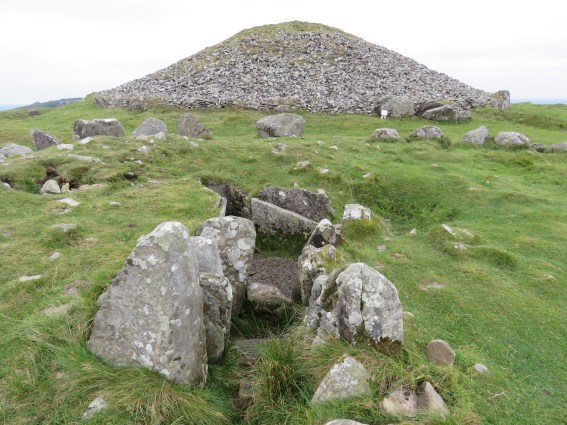
img_4383

Cairn T, with collapsed cairn in foreground

Opening the gate and entering the passage tomb feels like a huge privilege.

img_4292

Entrance way in Cairn T

The entrance and the chamber are lined with massive stones, carved with the most amazing rock art.


After leaving the passage tomb, I walked around the hill, soaking up the landscape. The cailleach is said to sometimes appear in the form of a crow, and on cue, one flew down and gave me a long and piercing look. Slightly unnerved, I concentrated on looking at the stone circles and the view from Loughcrew.


When we could no longer feel our fingers from the cold, and as dusk was drawing in, the druid and I walked back down the hill to the car park and the twenty-first century. And I had a large pot of tea and a warm bakewell tart in the coffee shop.

Further reading
McMann, J. 2005 Loughcrew: The Cairns: A Guide to an Ancient Irish Landscape. Oldcastle: After Hours Books.
Zucchelli, C. 2016 Sacred Stones of Ireland. Cork: The Collins Press.

Posted in Around the world, Folk traditions, Folklore, Ireland | Tagged , , , , | Comments Off on The view at Loughcrew

A few words on the art of sieving

Archaeologists use various tools to survey and excavate sites. Some are very expensive and require specialist expertise – see Geophys at dawn for images of us working on Baker’s Flat with some of that particular kit. Some are much cheaper and easier to recognise – I’m thinking plastic buckets and the archaeologist’s trowel here.

But something that is dear to my heart is the sieve. Archaeologists sieve excavated dirt so that smaller remains that have been overlooked in the trench can be found. When we excavated at Baker’s Flat earlier this year, we started by sieving every bucket of soil that was excavated. At some stages, depending on the needs of the trench, we sieved one in two buckets, or one in three.

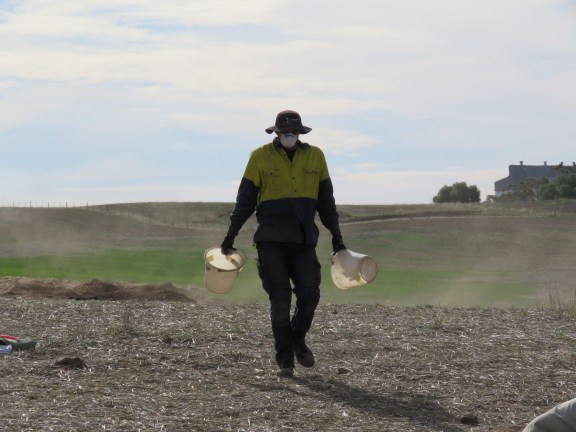
By the end of the dig, I estimate the sieved pile was about 16 tonnes of dirt. The  picture below shows the pile when it was tiny, and anybody that knows me may recognise the silhouettes of my two sons, who came to visit the site on a Saturday and were immediately drafted in to work.

IMG_3241

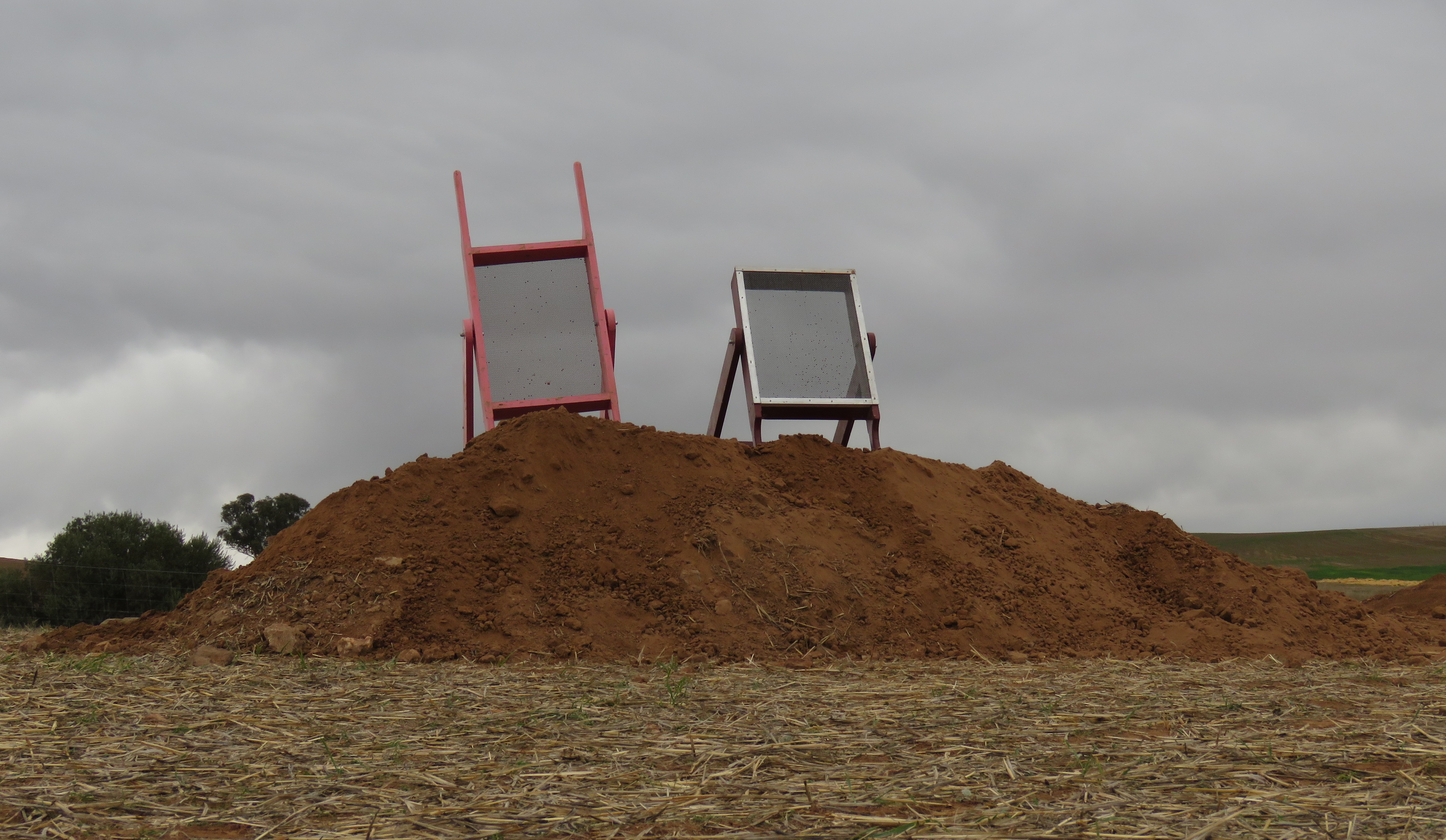
Below is the pile as it got bigger – two sieves standing sentinel waiting for the next buckets.
IMG_3349 cropped

And then there’s the lonely walk back to the trench, carrying the empty buckets, on a sort of Sisyphean journey – up and down the hill carrying buckets that are emptied only to be immediately filled again.IMG_3202

And the close examination of sieve contents. At Baker’s Flat, most of the material being found in the sieves were bits of rusty metal, most likely corrugated iron that had been used as roofing. But we also found two green glass beads, which might be the spangles or weights from a lace bobbin. And some metal trouser buttons – from hard-working Irish trousers? There were also numerous ceramic and glass shards.IMG_3520

And why do I love sieving so much? It always reminds me of Christmas. All that wrapping, in this case dirt, hiding small treasures.

Posted in Baker's Flat, Excavation, Field work, Kapunda, South Australia | Tagged , , , | 4 Comments

Shortlisted! Littlewoods Ireland Blog Awards 2016

Update 31 August 2016: I’m through to the finals! Thank you readers for the votes, and thank you judges for the judgement. 

I was very happy this morning to open my emails and see that Don’t Forget Your Shovel has been shortlisted for the Littlewoods Ireland Blog Awards 2016 in the Diaspora category, sponsored by Littlewoods Ireland.

Thanks to everybody for reading the blog and making comments, and to the judges who thought the blog merited being shortlisted. If you want to cast a vote, you can click on the picture below. Voting closes on 23 August, and 20% of the vote is from blog readers, 80% from the judges.

Littlewoods-Blog-Awards-2016-Website-MPU_Vote-Now

Posted in Ireland | Tagged , , | 4 Comments

Baker’s Flat: a reenactment

In 1880, the Kapunda Herald gave an account of an incident on Baker’s Flat involving several of the Irish women living there and some unfortunate would-be fencers. It went something like this.

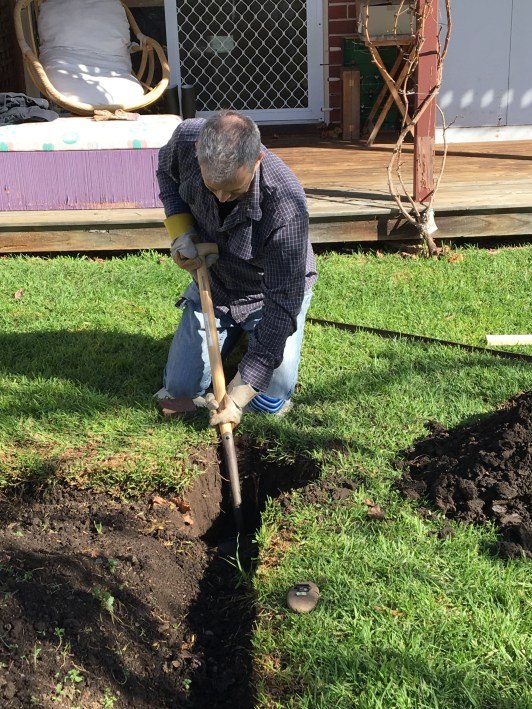
Three men – William Grabert, Francis Pinn and Robert Hooper – were employed to fence a section on Baker’s Flat. So, bright and early of a Wednesday morning, the men went fencing. They brought a shovel, a pick and a crowbar.

Their arrival on Baker’s Flat was greeted by scores of ‘wives and mothers, who turned out to drive off the would-be despoilers of their hearths and homes’, armed with brooms, sticks and shovels. The women included Ann Slattery, Mary Callaghan, Mary Lacey, Ann Hoare, Catherine Driscoll and Mary Jose.

The fencers were not deterred. Brave and manly men, they were determined to do their duty and dug a hole for the first post.

IMG_2499

The first hole is dug

There were some choice words and threats from the women, who called the fencers ‘vagabonds’, and threatened that they would lose the last drop of their blood before the men could put a pick in the ground. And the men were frightened because the women had sticks, especially Mrs Callaghan who had a ‘good-sized one’. William Grabert told the court later that he had received several pokes in the ribs.

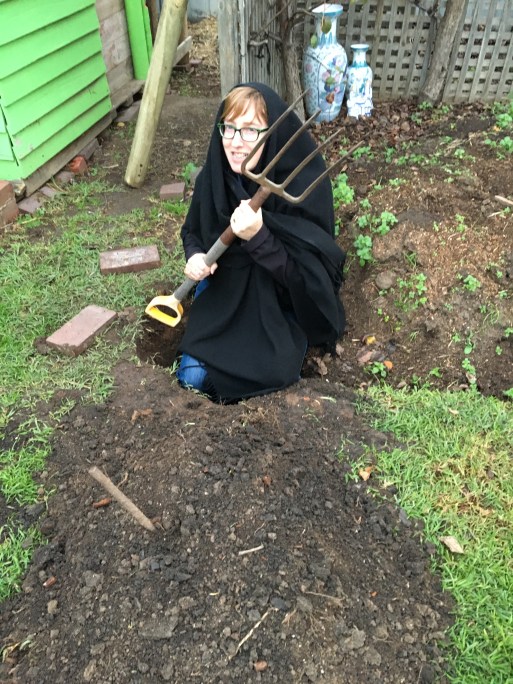
The fencers managed to make a start, but then, after a small skirmish, Mrs Callaghan was able to sit herself in the partially sunk hole, and declare that ‘You will have to sink a hole through my body before you sink a hole in the ground’.

IMG_2506

Over my dead body!

The three fencers went into a huddle, examined their options, and took the decision to retreat, ‘leaving the fair army in triumphant possession of the field’.

They had to leave by crossing the River Light, jeered along the way, including by one woman who told another to ‘do something’ in her shovel and she would plaster their faces with it. On the positive side, no stones or cow dung were thrown! The men later stated they were very glad indeed to get safely home.

Full accounts can be found in the following Kapunda Herald reports:
7 May 1880, p.2
1 June 1880, p.2
4 June 1880, p.4

Posted in Baker's Flat, Kapunda, South Australia | Tagged , , | 4 Comments

Notes on the Cascades Female Factory, Hobart

In Hobart for a short visit, today I discovered the Cascades Female Factory, Australia’s most significant prison site associated with colonial female convicts. It’s one of the 11 sites that together comprise the World Heritage listed Australian Convict Sites. Although only one building is still intact, the remaining high walls and recent interpretation give a profound sense of what life would have been like at Cascades in the mid-nineteenth century.

Between 1788 and 1853, about 25,000 women were transported to Australia from Britain and Ireland. More than half of these women came to Van Diemen’s Land (Tasmania). And thousands of them spent time at Cascades, which operated from 1828 to 1856.

147

Representation of a woman and her young child at Cascades

On arrival, the women would wait in the entrance area of Yard 1 until a decision was made about where they would go. The words at the entrance, shown below, are taken from official reports, and highlight the subjective judgments that were made, primarily by men. They indicate how powerless these girls and women would have been in having any influence over what happened next in their lives.

169

Unmanageable, angry, numb, healthy, beautiful – official judgments

At decision time in Yard 1, the options weren’t great. If you had already been cast as ‘unmanageable’, ‘notorious’ or even ‘savage’, it was off to Crime Class with you – wearing a large C on the back of your dress, lousy food, hard hard work. It got a little better if you were assigned to Second Class – the C was smaller in size and worn on your sleeve, the food was a little better, the work was still hard but mainly sewing rather than backbreaking laundry work. First Class was best – you might work as a cook, task overseer or hospital attendant.

Damp conditions, poor sanitation and inadequate nourishment all took their toll on the inmates. There were high rates of illness and mortality amongst the women, and also in their children. Transported women were sometimes accompanied by their young children, and women who became pregnant would stay with their babies until they were weaned at six months (later nine months). At that point, the mothers had to leave the nursery quarters, and go to another part of the facility to complete their sentence. The children were kept at Cascades until they were three years old, although their mothers only saw them from time to time.

154

Empty cradles represent the infants who lived at Cascades

For more information about the female convicts of Tasmania, check out the Female Convicts Research Centre; membership is free and entitles you to access their database.

References:
Female Convicts Research Centre 2012 Convict Lives: Women at Cascades Female Factory. Hobart: Convict Women’s Press.
Frost, L. 2004 Footsteps and Voices: A Historical Look into the Cascades Female Factory. Hobart: Female Factory Historic Site.

Posted in Around the world, Migration | Tagged , , , , , , , , , | 2 Comments