Nollaig na mBan 2016

When I was growing up in Ireland, my only experience of Nollaig na mBan (Women’s Christmas) was through Seán Ó Ríordáin’s poem, which I remember learning in Irish for the Inter Cert when I was about twelve. I was sure there was a goat in it somewhere, but that was probably my poor Irish, and when I see the translation below (thanks to the Irish Times), I think I must have confused gealt (lunatic) with gabhar (goat) – my Irish has never been brilliant.

I didn’t realise until some years later that Nollaig na mBan is still  strong in the west and south of Ireland. It’s celebrated on 6 January, twelfth night, and translates as Women’s Christmas. Importantly, it is a celebration by women of women. It marks the official end of Christmas, where women get together and celebrate their hard work over the Christmas period with a feast of shared food, drink and conversation.

In Adelaide, we have been celebrating Nollaig na mBan with a core group of women for the past fifteen years or so. We gather in the evening as it gets dark. Ideally, it is neither too hot nor too cold to sit outside. This year it was perfect, and eighteen women gathered round candle-lit tables in the back garden, bringing plates of food to share, and drinking Pimms, champagne and copious cups of tea. It comes to a close when the last person goes home.

Nollaig na mBan

Nollaig na mBan, Adelaide, January 2016

The tradition of Nollaig na mBan is not well documented. It was described in a 1998 newspaper article as ‘a custom which seems to have been passed on orally and informally, drifting down like feathers from one generation to the next’. So this post stands as a witness to its continuation into the 21st century, with Irish women standing strong for a festival worth having.

And here is the poem, as Gaeilge first and then in English, and also read here by Tadgh MacSuibhne:

Oíche Nollaig na mBan
Seán Ó Ríordáin

Bhí fuinneamh sa stoirm a éalaigh aréir,
Aréir oíche Nollaig na mBan,
As gealt-teach iargúlta tá laistiar den ré
Is do scréach tríd an spéir chughainn ’na gealt,
Gur ghíosc geataí comharsan mar ghogallach gé,
Gur bhúir abhainn shlaghdánach mar tharbh,
Gur múchadh mo choinneal mar bhuille ar mo bhéal
A las ’na splanc obann an fhearg.

Ba mhaith liom go dtiocfadh an stoirm sin féin
An oíche go mbeadsa go lag
Ag filleadh abhaile ó rince an tsaoil
Is solas an pheaca ag dul as,
Go líonfaí gach neomat le liúrigh ón spéir,
Go ndéanfaí den domhan scuaine scread,
Is ná cloisfinn an ciúnas ag gluaiseacht fám dhéin,
Ná inneall an ghluaisteáin ag stad.

Women’s Christmas
Seán Ó Ríordáin, translation by Theo Dorgan

There was power in the storm that escaped last night,
last night on Women’s Christmas,
from the desolate madhouse behind the moon
and screamed through the sky at us, lunatic,
making neighbours’ gates screech like geese
and the hoarse river roar like a bull,
quenching my candle like a blow to the mouth
that sparks a quick flash of rage.

I’d like if that storm would come again,
a night I’d be feeling weak
coming home from the dance of life
and the light of sin dwindling,
that every moment be full of the screaming sky,
that the world be a storm of screams,
and I wouldn’t hear the silence coming over me,
the car’s engine come to a stop.
Posted in Folk traditions, Ireland, South Australia | Tagged , , , , | 4 Comments

The things you see in Rundle Mall

It’s been Christmas here of course. And in case that time of year isn’t busy enough, it also coincides with end of school year graduations, suppers, dinners, etc. Just as well I am a social being.

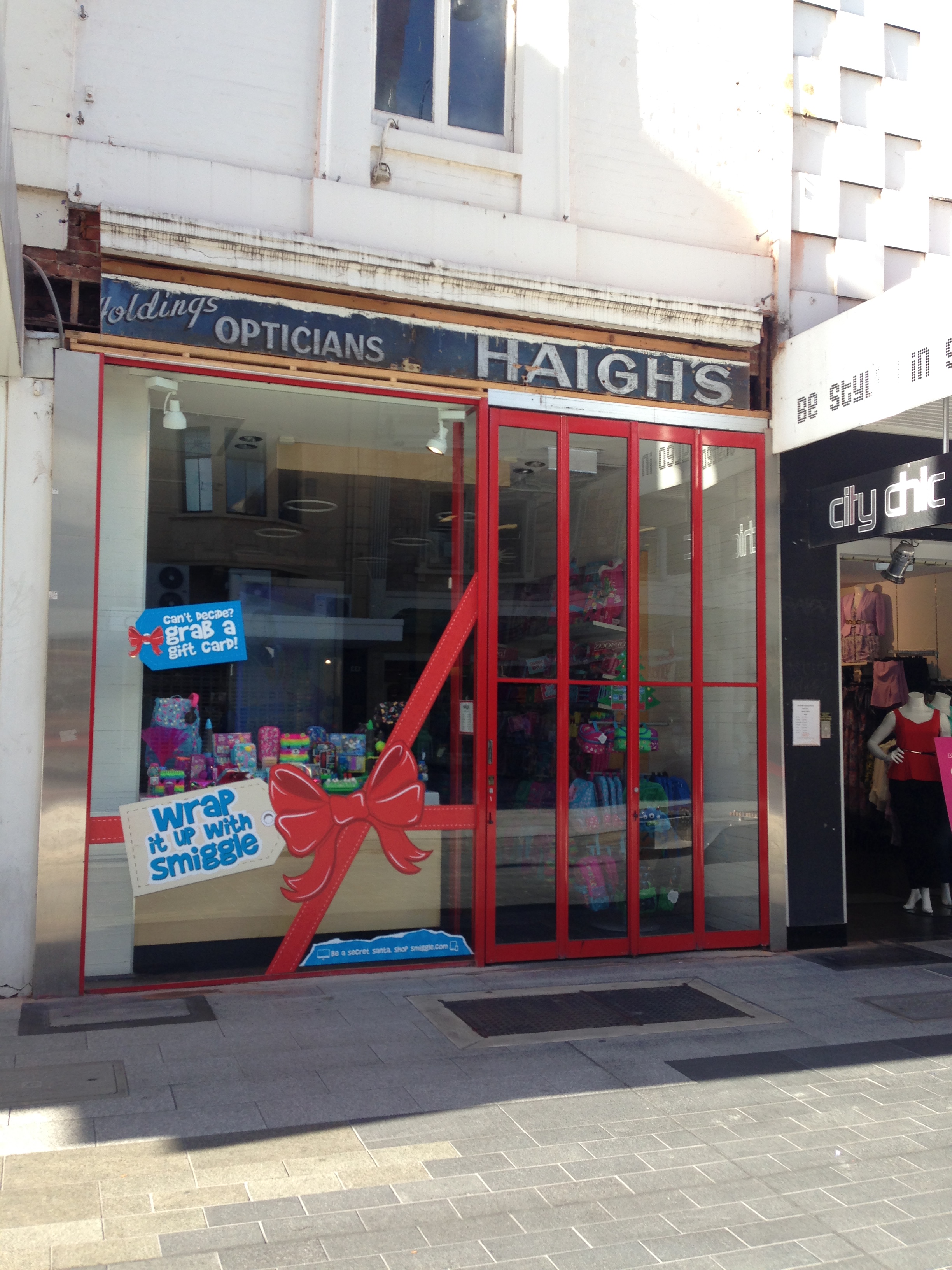
Anyways … one of the graduation events for my boys took place in the Richmond Hotel in Rundle Mall, a prime shopping spot in the heart of Adelaide. On that evening, the Smiggle shop was getting a makeover, in the form of a new overhanging verandah. And for a very short time, a section of the original shopfront was exposed.

Haigh's, its cover blown

Haigh’s, its cover blown

Wonder of wonders, a sign for my favourite chocolate – Haigh’s – established in 1915, and the oldest family-owned chocolate maker in Australia. Their chocolate speckles and scorched almonds have got me through many a crisis, and the cinema mixture has something to please everyone. As for the rocky road which is only made from Easter to the end of September – it (and its heat-intolerant marshmallow) heralds the beginning of autumn, a season which I far prefer to the arid Adelaide summer.

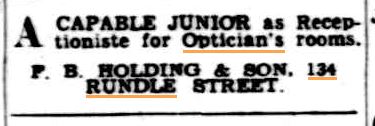
As you may have intuited by now, I have given the Haigh’s range a fair go over the years. However, back to the revealed sign. The Smiggle shop is at 134 Rundle Mall, but the history page on the Haigh’s website doesn’t refer to a shop at that location, and a search on Trove doesn’t find any easy reference to it either. However, the opticians is easier to locate. It seems to have been there since the 1930s, and in January 1953, FB Holding & Son advertised for a capable junior to act as receptioniste [sic] for their optician’s rooms at that address (at that stage Rundle St was still a street, it didn’t become a mall until 1976).

A capable junior as receptioniste

A capable junior as receptioniste

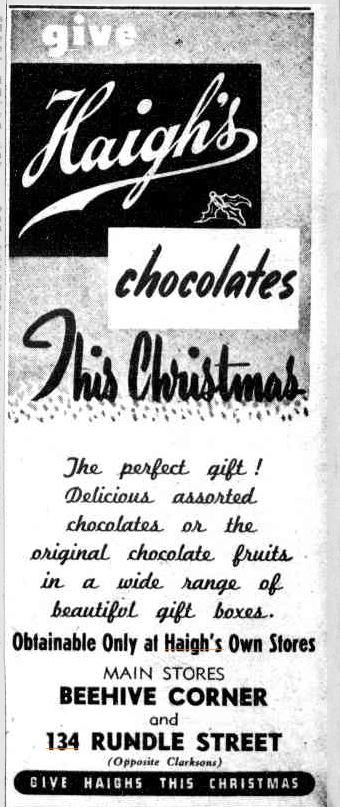
In March 1953, a girl, aged 16, working as an optician’s receptionist advertised for board and lodging, giving her contact details as Holding’s at 134 Rundle Street. It may not have worked out for her, however, as Holding’s were advertising for another junior receptionist within the year in January 1954. Perhaps she left before Haigh’s moved in, because who would leave after? In December 1954, Haigh’s advertises its chocolates as ‘The perfect gift! Delicious assorted chocolates or the original chocolate fruits in a wide range of beautiful gift boxes’  – that at least has not changed.

Give Haigh's chocolates this Christmas

Give Haigh’s this Christmas

When we walked by Smiggle again, just over an hour later, the sign was completely covered, and was once again a part of Adelaide’s hidden heritage.

Posted in South Australia | Tagged , , , , , , | 10 Comments

A story for the night that’s in it – take care on Halloween

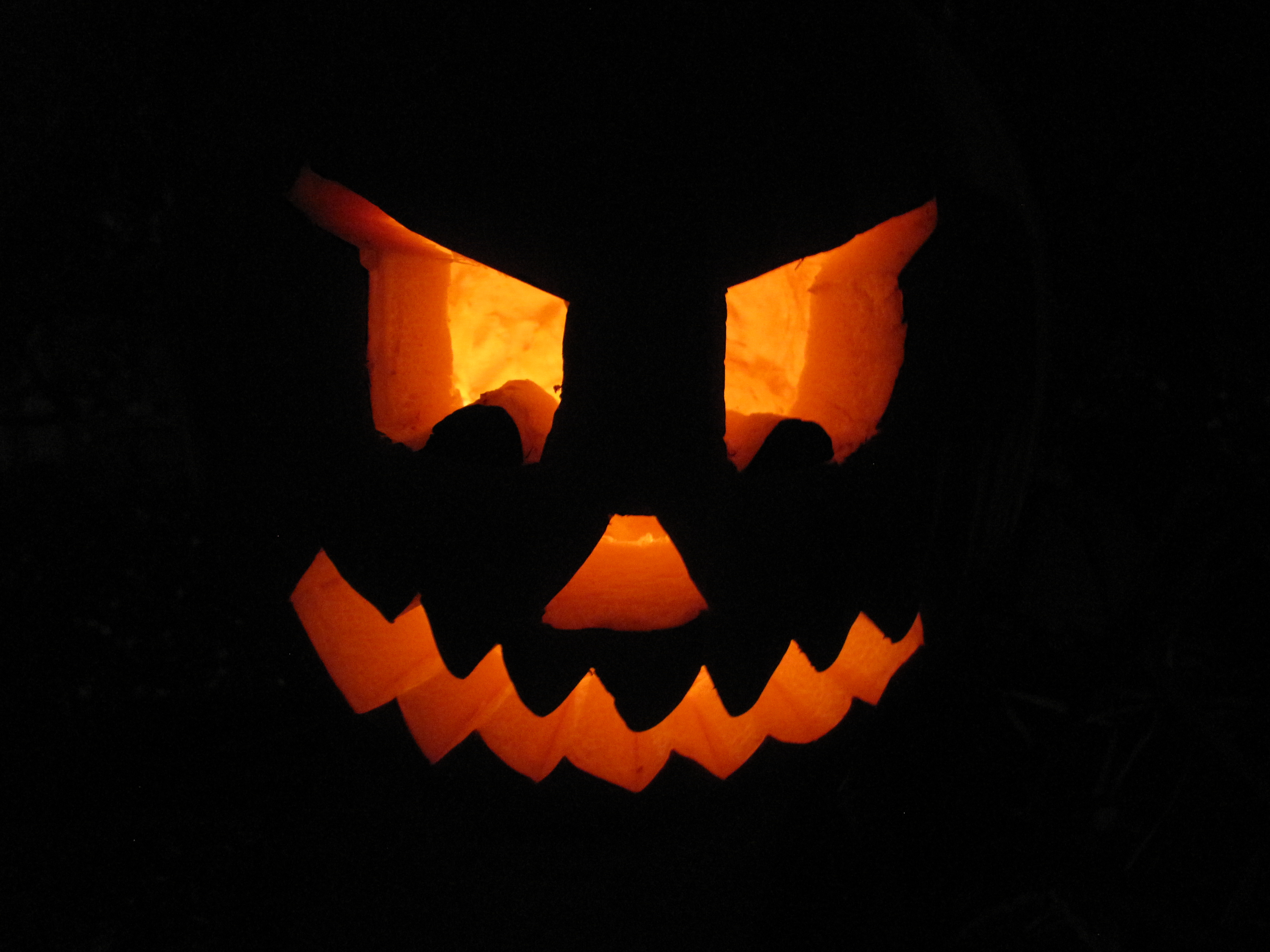
Halloween lantern

Halloween lantern

They say that the fairies are happiest on Midsummer Eve when the bonfires are lit, but that on Halloween they’re at their gloomiest for it’s the start of the winter. This is the night when the veil between our world and theirs is at its flimsiest, when the ghosts dance, the witches cast their spells, and the pooka is out and on the prowl.

The story below is from the manuscripts of the National Folklore Collection in UCD, and tells of how the attempted abduction of a young girl was foiled because she carried a pair of metal tongs. Metal objects are well-known for their strong protective properties against supernatural beings, it was just as well she had the forethought to be carrying them.

“Long years ago there was a house in our back field, and a man named Mylie Reilly was living in it. One evening his daughter went out to bring home the ducks, and lucky enough, she happened to bring the tongs with her. She was putting the ducks out of the river when she was seized by the ‘gentry’ [the fairies]. They brought her a ‘mile of ground’ but they had to let her go because she had the tongs with her. She was half the night away and her people were out looking for her. She was all torn by bushes and briars when she got back home.”
(Barney Gargan, Tierworker, collector PJ Gaynor 1941, NFC 792-447 – Cited in Marsh, R. 2013 Meath Folk Tales. Dublin: The History Press.)

Boo

Boo!

And because Yeats is one of my favourite poets, a couple of verses from The Stolen Child, which is even better if you listen to the fabulous Waterboys singing it.

Where dips the rocky highland
Of Sleuth Wood in the lake,
There lies a leafy island
Where flapping herons wake
The drowsy water-rats.
There we’ve hid our faery vats
Full of berries,
And of reddest stolen cherries.
Come away, O human child!
To the waters and the wild,
With a faery, hand in hand,
For the world’s more full of weeping than you can understand.

Away with us, he’s going,
The solemn-eyed;
He’ll hear no more the lowing
Of the calves on the warm hillside.
Or the kettle on the hob
Sing peace into his breast;
Or see the brown mice bob
Round and round the oatmeal-chest.
For he comes, the human child,
To the waters and the wild,
With a faery, hand in hand,
For the world’s more full of weeping than he can understand.

Posted in Folk charms, Folk traditions, Folklore, Halloween | Tagged , , , , , , | 2 Comments

In search of a clachan, and Fr Ted’s house

During my wanderings in Co. Clare recently, I was studying a map and saw a reference to a Deserted Village. Well, that was enough to pique my interest, and I determined to try and find it the next day. I worked out my route carefully, selecting a clockwise direction to make the best use of time. Woke up bright and early, made a quick detour to Ennis for a cup of tea and a look at the well-worth-it Friary, then off to Corofin for the museum and the pottery.  I had allowed time for a short stop at Killinaboy Church because it has a very well-preserved sheela-na-gig above the door in the south wall.

Sheela-na-gig, Killinaboy Church, Co. Clare

Sheela-na-gig, Killinaboy Church, Co. Clare

At this point, I realised I was less than a mile from Fr Ted’s house, and who wouldn’t go and have a look, given the opportunity? Next time, I am definitely going to stop and have tea there.

Fr Ted's Parochial House, Co. Clare

Fr Ted’s Parochial House, Co. Clare – you can have tea there

At this stage, hunger was getting the better of me, so I decided to change direction to clockwise, because this would get me to Ballyvaughan more quickly, and the prospect of a pot of tea and a BLT was very enticing. Stopping only for a few moments at Carron Church (12th century walled church, with a marker cairn) and Poulnabrone Dolmen (Burren icon), I was successful in Ballyvaughan, but was now heading towards the Deserted Village much later than I had planned.

Poulnabrone Dolmen, Co. Clare

Poulnabrone Dolmen, Co. Clare

Still, it was June and the days were long. I followed my Ordnance Survey map, passed the turnoff on the left where I thought it might be, and decided to drive to the next crossroads to make sure. There, I met an old man, who told me that I was at the right place, but that it was on private land and not publicly accessible. However, by sheer good fortune and the luck of having arrived in that exact spot three hours after I had planned, he pointed me to the jeep that I was blocking on the road and which happened to hold the landowner. After a brief conversation about why an archaeologist from Australia would be interested in his deserted village, he led me up some unmarked roads and showed me the walking route up the hill.

And at the top of the hill, in the mist, I walked into the remains of a clachan. Clachans were a particular type of settlement in Ireland,  common in the 18th and 19th centuries, but pretty much gone from the landscape by about 1900. Essentially, they were a group of farm dwellings and outbuildings that were clustered together, and the people who lived there farmed the surrounding land communally. Unlike standard villages, clachans didn’t have services like a church, shops or pubs.

The remains of a clachan, Co. Clare

The remains of a clachan, Co. Clare

All the indications are that Baker’s Flat was a clachan, the first to be recognised as such in Australia, hence my excitement at this one in Clare. The rain came in, and I got soaked through, because I’d foolishly left my raincoat in the car. And when I got back to where I was staying, I left my shoes outside because of the muck, and a cat peed on them during the night. But my excitement has remained undiminished.

Posted in Baker's Flat, Clachans, Folk traditions, Ireland, Kapunda, Settlement systems | Tagged , , , , , , , , , , , | 6 Comments

Sailboat prayer tokens and Arthur graves at the Ennis Friary

The Ennis Friary in Co. Clare, Ireland was founded for the Franciscans around 1284 by the O’Brien family. It’s had an interesting history, remaining active under O’Brien protection until at least 1570. Later it came under the auspices of the Church of Ireland, during which time the bell tower was hit twice by lightning and had to be rebuilt.

On one of the internal pillars is the remains of plaster work from the 14th or 15th century, with four or five pieces of graffiti depicting sailboats. There are not interpreted as vandalism but as prayer tokens. The pillar is located in the nave where the congregation would have stood. And the sailboats are seen as a spiritual or religious practice – a prayer for a fisherman’s safe return or a good catch, for the safekeeping of a person on a voyage, or maybe even as a symbol of Christianity (Jesus as the fisher of men).

Graffiti of a sailing ship, Ennis Friary, dating from 14th or 15th century

Graffiti of a sailing ship, Ennis Friary, dating from 14th or 15th century

As I explored (and I can highly recommend a visit to the friary – great interpretation and very helpful staff), I came across an Arthur grave dating from 1830 – perhaps a distant relative using the more standard spelling? It was erected as a ‘humble tribute of affection’ by Patrick Arthur for his wife Mary Arthur alias Considine. And a nice nineteenth century verse to keep us humble:

All you good people who now stand by
As you are now so once was I
As I am now so you shall be
Remember death and pray for me

The grave of Mary Arthur in the grounds Ennis Friary, who died in 1830 aged 45 years

The grave of Mary Arthur in the grounds Ennis Friary, who died in 1830 aged 45 years


Posted in Around the world, Folk traditions, Ireland, Museums | Tagged , , , , , , , , , , | Comments Off on Sailboat prayer tokens and Arthur graves at the Ennis Friary