Trees, part 1 – tree of knowledge

With Christmas looming, and a house in the middle of some minor but disruptive renovations, what to do with all the books piled in the room that is about to be slept in by visitors? Enter the Christmas book tree. Enrobed with tinsel and lights, topped with tinfoil holly, it has been the perfect solution for the Christmas season.

Christmas tree of knowledge

Christmas tree of knowledge

Apparently, the Flinders University Library did the same thing successfully a couple of years ago with law reports – being green and of similar sizes. And it has been suggested that next year I could try it with archaeology books – it would be a smaller tree.

Posted in Fairy trees, Folk traditions | Tagged , , | 5 Comments

Halloween – Samhain

Here’s something to frighten the life out of you – a lantern for Halloween in the traditional fashion, hollowed out of a turnip. On display in the Museum of Country Life, Turlough House, Mayo.

Turnip lamp, Museum of Country Life, Co. Mayo

Turnip lamp, Museum of Country Life, Co. Mayo

The door’s on the latch
The turf burns red
Turn low the lamp
And go to bed.

For on this night
Them that’s away
Could be back again
Out of the clay.

They’ll come in the dark
To the warm turf
From the coul’ sod
And the wet surf.

And you in the loft
Can breathe a prayer
For the wakin’ dead
That’s gathered there.

From All Soul’s Night by John O’ The North


Posted in Around the world, Folk traditions, Halloween, Ireland | Tagged , , , | 1 Comment

No Irish need apply

After recalling the old stories about 1950s London when boarding houses and shops had signs in their windows that No Irish Need Apply, I thought I might have a little trawl through the nineteenth century South Australian newspapers on Trove. To be perfectly honest, I was quite astounded when lots of search results were returned.

The earliest ad I found in South Australia was from 1852 where Mrs Nelson of Franklin Street, Adelaide promised good wages to a servant of all work, but no Irish need apply. The same story continued through to the 1900s for general servants, nursemaids, plain cooks and respectable girls – all in demand as long as they weren’t Irish.
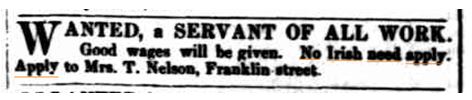
Wanted, a servant. No Irish need apply.

Wanted, a servant. No Irish need apply

In 1855, Mrs Edmund Wright (wife of the architect, perhaps) advertised for a nursemaid at Palmer Place, North Adelaide, with the proviso that no Irish need apply. This time, there was a quick response – from E McEllister three days later who posted his own advert to Irishmen in South Australia, drawing their attention to Mrs Wright’s stipulation.
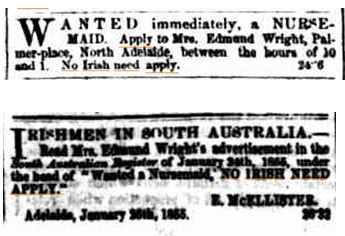
A nursemaid (not Irish) is sought. The Irish are alerted through a subtle response.

A nursemaid (not Irish) is sought. The Irish are alerted through a subtle advert response

The 1880s and 1890s saw three ads in the Matrimonial section of the paper forbidding Irish application. In each instance, two respectable young gentlemen from various country towns were seeking to correspond with two young ladies (not Irish of course) who must be good looking, fond of home and children, musically inclined, well-educated, all with a view to matrimony.
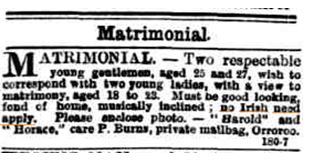
A view to matrimony, as long as you're not Irish.

A view to matrimony, as long as you’re not Irish

And this not so subtle racism continued in humorous newspaper articles, such as the example below where an Irish man in search of work attempts to subvert his origins by saying “Shure an’ couldn’t ye persave by me accint that it’s Frinch I am”.
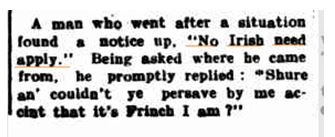
And what about the French?

And what about the French?

Comments welcome, because I’m still speechless!

Posted in Migration, South Australia | Tagged , , , | 4 Comments

The beginnings of bureaucracy

In 1845, the colony of South Australia was less than ten years old. But already, files were being created and documents saved as a bureacracy took its first steps alongside the colony.

Here’s a letter that made me smile. Dated 18 July 1845, it’s from Thomas Lipson to Captain O’Halloran requesting the loan of a cart for conveyance of a mast.

Loan of a cart

Loan of a cart

He says – Dear O’Halloran, I think there is a cart belonging to the Engineers Department – could you have it sent down this afternoon or tomorrow, to take a mast and a few things that I want to send up for the flagstaff at Government House, and I will send the men up on Monday morning to get on with it. Yours very truly, Thos Lipson

Government House Adelaide is the oldest government house in Australia. The earliest part, the east wing, was completed in 1840. Extensions were added in 1846. And the letter makes me wonder – does the same flagstaff still stand at Government House?

Posted in Around the world, South Australia | Tagged , , , | Comments Off on The beginnings of bureaucracy

Eureka! Archival wonders

That moment in the State Records Office when you read something that proves something.

I was in State Records a little while ago, way out north at Gepps Cross*, a flask of tea and a sandwich sort of journey from where I live. And goodness, but it is a fabulous place. There are people working there that get as excited as I do about finding specks of useful knowledge in old bits of paper. And researchers that overhear your conversations and then turn up with books that they think you might be interested in.

I was there to keep working my way through the court papers for an 1892 case in the Supreme Court of South Australia. This case went on for a decade, and was pivotal for the Irish of Baker’s Flat around their rights, or not, to occupy that land. The papers so far have been useful in determining the names of some of the Irish who lived there, how much land they worked, and what sort of house they had.

Forster et al. v Fisher court records, dating from 1892

Court records for Forster et al. v Fisher, dating from 1892

But the eureka moment was when I was working my way through the 34th packet, then the 36th, 38th and 40th – deep in the case papers. And there they were. Affidavits from an unfortunate Kapunda solicitor who had to try to negotiate with six Baker’s Flat residents to purchase their land from the legal owners ‘on reasonable terms’.  He wasn’t received well. Ann Bolton told him that if he returned, she would throw scalding water over him. John Quigley just refused to listen to him at all. Austin Quin said that if anyone came to turn him out, they would be put into the big water hole in the River Light.

But the really interesting bit was that these individuals were acting together. From the court papers, it can be seen that they have received legal advice, and are acting in solidarity to give the same message to the powers that be – clear off, we were here first, and we’re not leaving. Using the system to fight the dominant power.


* State Records is moving its public access service into the city in August, and will be open for business in the State Library on North Terrace from 4 August.

Posted in Baker's Flat | Tagged , , , , , , | 6 Comments