The henhouse

‘Very poor people, in the past, were wont to keep their little stock of hens or ducks in a small pen made from an old box in the kitchen …’ (O Danachair 1964). This was a custom in Irish rural houses in the nineteenth and even the twentieth centuries. It made sense, particularly for hatching birds, to keep them in the warmth of the kitchen; dressers were commonly designed to hold the delph (crockery) on the upper part, with the lower section divided into nesting boxes.

And here we are, in the depths of the South Australian winter, and the new guardians of 14 day old chicks. And no, we couldn’t possibly put them out in the cold. So we’re tapping into our Irishness, and they’re carefully penned in the laundry in an old wooden box. Note the canny re-use of an IKEA lamp as a heat source, and some 20 year old sheets as insulation. Four new girls, election hens, yet to be named but possibilities include Julie, Tanya, Billie and Mallie.

Reference
O Danachair, C. 1964 The combined byre-and-dwelling in Ireland. Folk Life 2(1):58-75.

Posted in Folk traditions, Ireland, South Australia | Tagged , | 2 Comments

The excavation of Baker’s Flat – a tale of the Trench A dugout

From April through to the beginning of May, I led a trusty band of volunteers in the first excavation at Baker’s Flat. For me, this was an experience that engendered a wide range of emotions. At some stages I was filled with excitement, joy, exhilaration. At others, it was more like fear, apprehension, trepidation. So much thinking – before, during and after the excavation – encapsulated in the photo below, of me deep in thought.
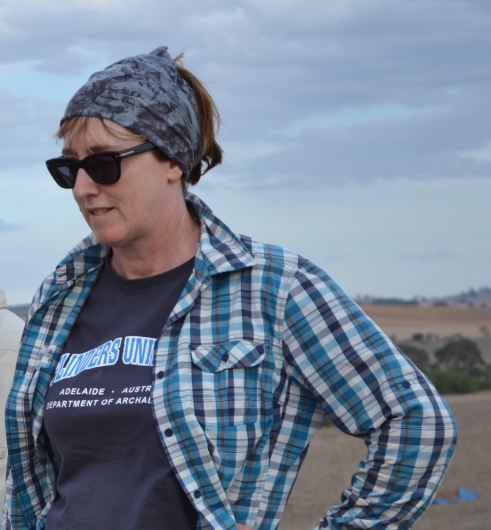
Susan thinking. Photo: C De Leiuen

Susan thinking. This occurred frequently, and sometimes even to good effect. Photo: C De Leiuen

If you glance back to my previous blog post about the geophys and the first picture of the results (scroll down!), you’ll see some clusters of white blobs near the top left. These results helped me make the decision to open Trench A at the location shown below. Sure, it looks like a random spot in an otherwise empty paddock, but it was precisely chosen to cut across the area that I believed held structures.
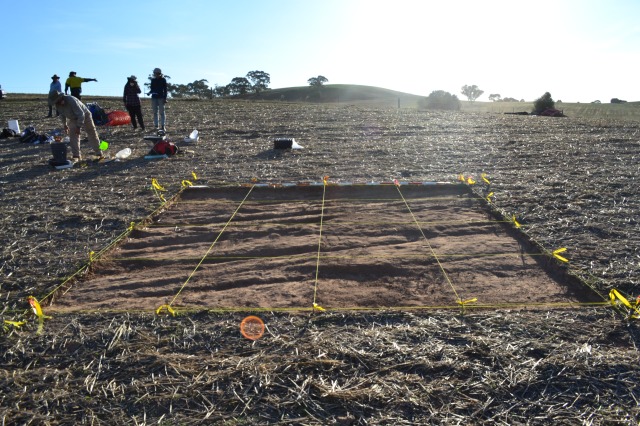
DSC_0111

Trench A, context 002, plough lines exposed. Photo: C De Leiuen

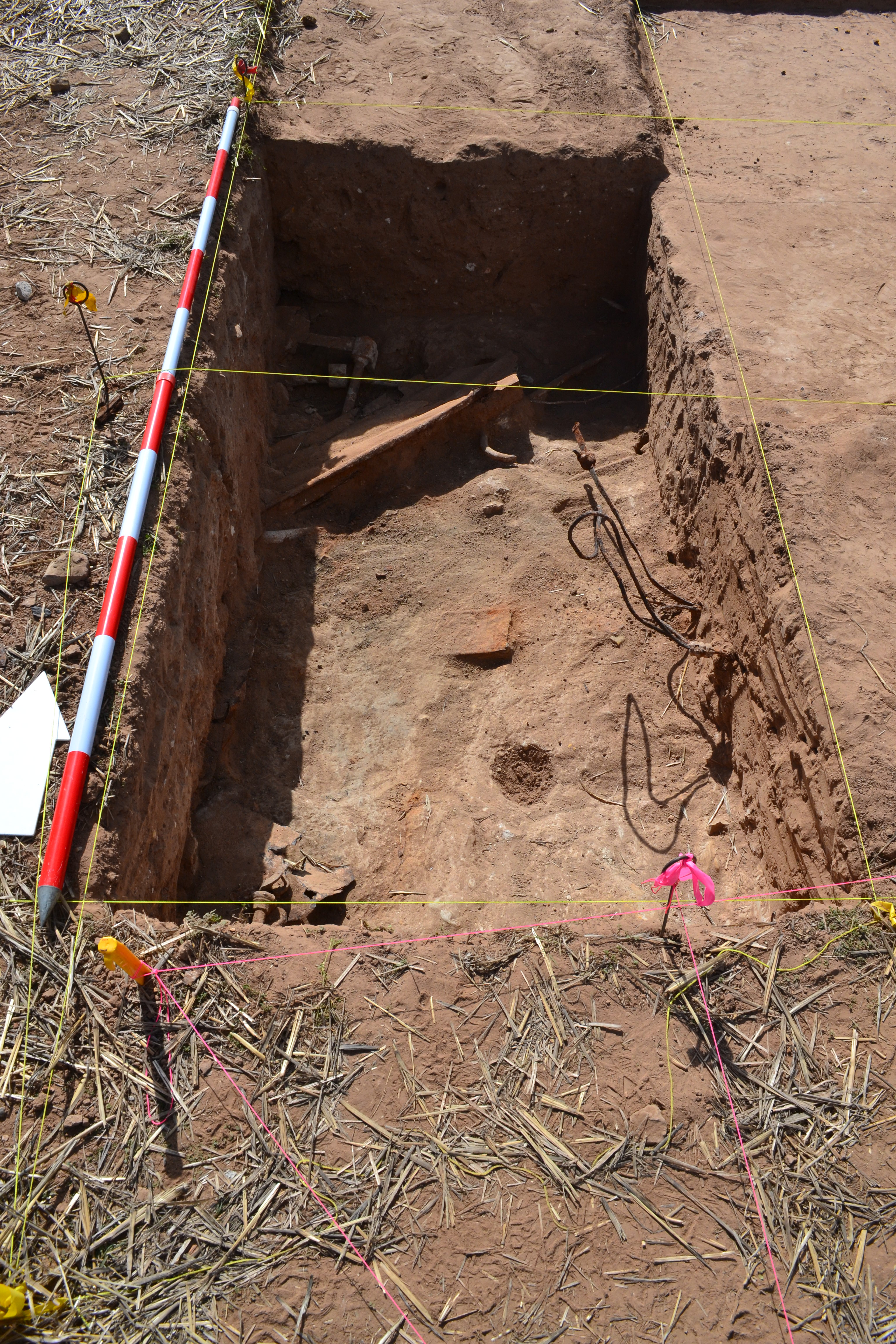
On day five, things started to get interesting. You can see in the photo below that there are metal artefacts emerging. And just as exciting, two round post holes – one near the southern end in the image below, and another under one of the bars from a bedhead (yes, that’s what those twisted bits of wire are). Incidentally, the rusty-looking rectangular object between the post holes turned out to be a very large and heavy door lock case.
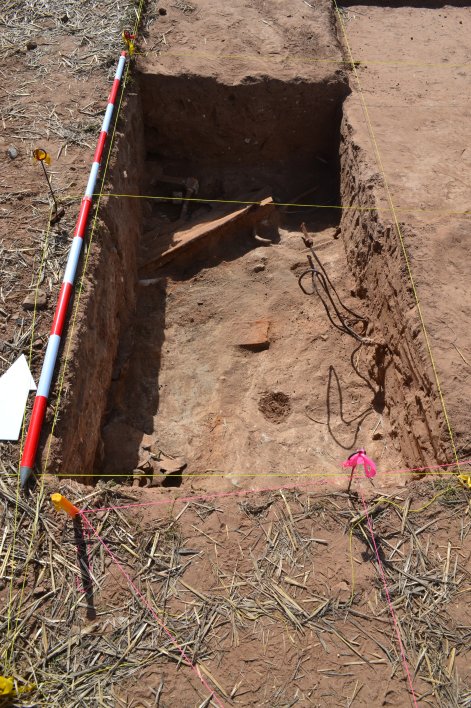
DSC_0206

Trench A, squares x16:y20 and x16:y21, context 004. Photo: C De Leiuen

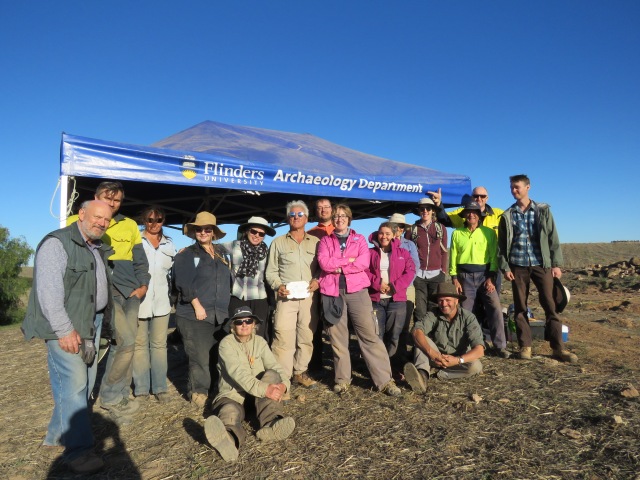
At about this stage, I had to say a sad goodbye to the first lot of excavators, the crew from this year’s Conservation Field School. However, in true archaeological tradition, a couple of them returned later in the season bringing, respectively, scones and beer. So yay for Flinders archaeology students!
IMG_3286

Students and staff from Flinders University Archaeology Department. Conservation Field School 2016. Photo: H Burke

The digging continued, and when you look at the photo below, you can perhaps marvel at the fact that most of the dirt from this trench was removed using small trowels. In reference to the image above of two squares in Trench A, you can still see the bedhead at the bottom right of the picture below, and the rusty rectangle where the door lock case had been.

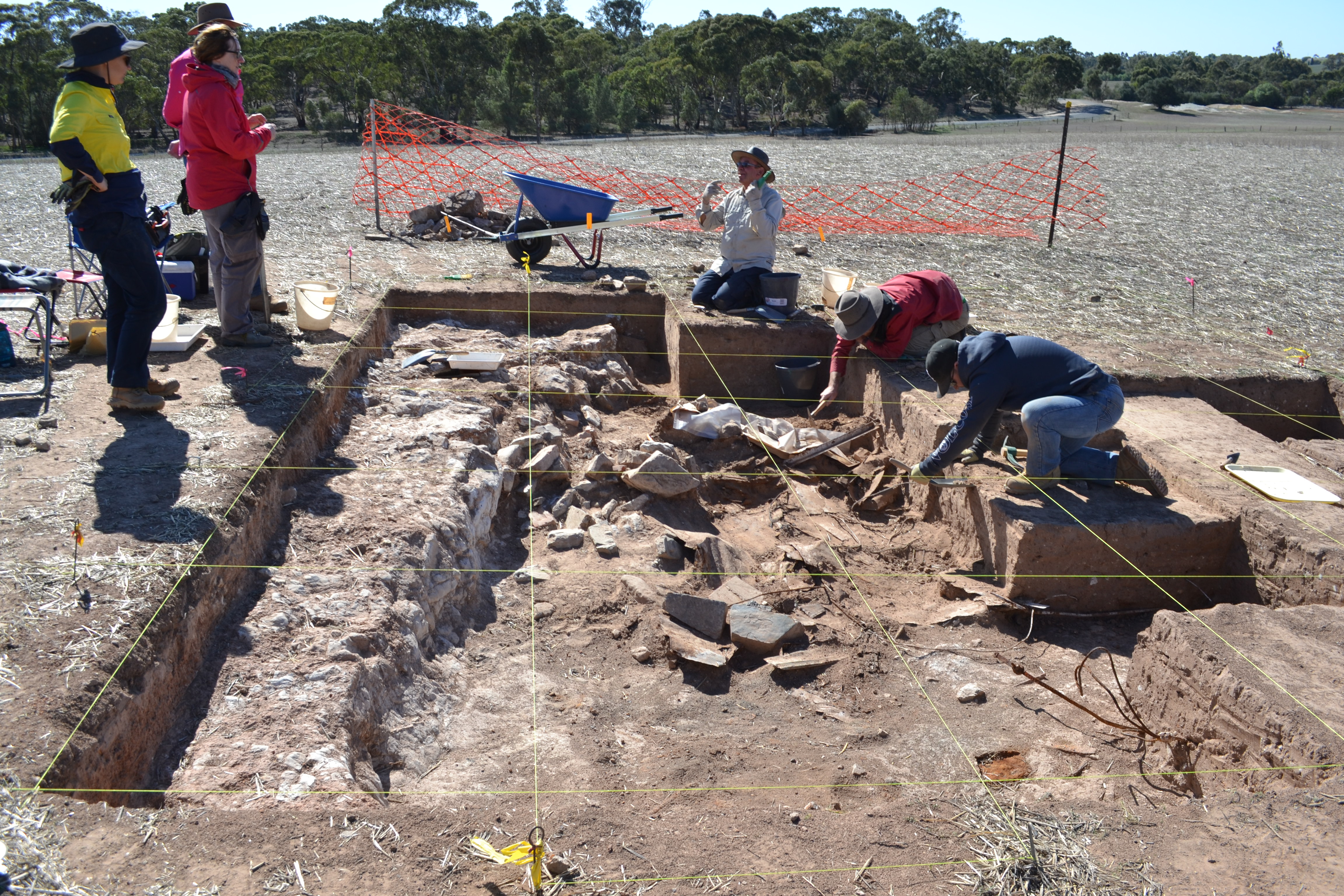
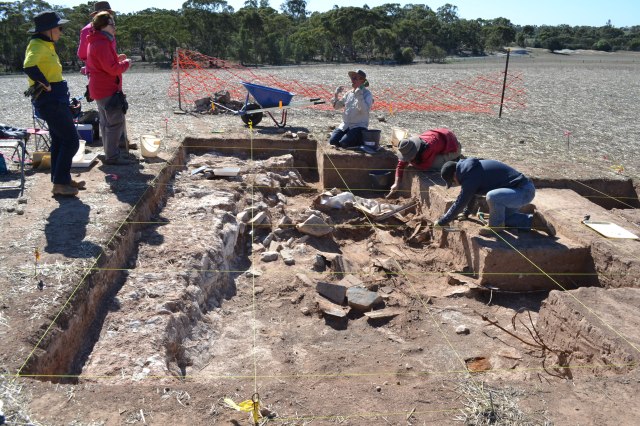
We extended the trench west (left side of the picture), and at the stage shown below, we had exposed the dugout wall and were beginning to get hints of the floor surface to the east. The area where most of the work is happening was a collapsed roof comprised of thatch and a later surface of corrugated iron. This was being removed slowly and carefully, and clearly needed at least the same number of people watching as working!
DSC_0411

Trench A, workers and watchers. Photo: C De Leiuen

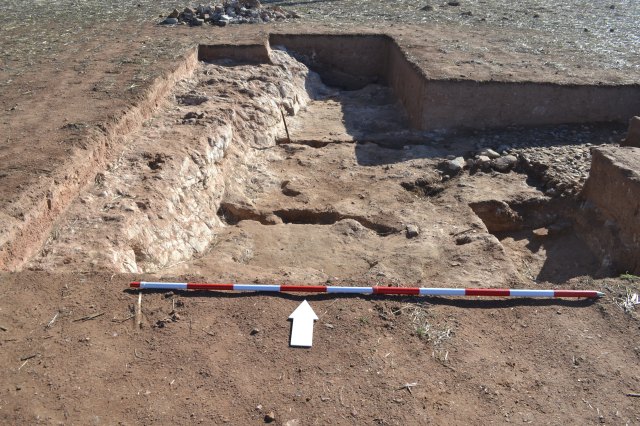
At the completion of this year’s field season, here is Trench A and its dugout revealed. The dugout wall is at the west side. Those hardy Irish migrants would have dug into the rise of the hill to form a shelter wall, and continued to dig out a level floor surface to the east, including channels to form partitions.

Given my recent experiences with dust and wind on the rise of Baker’s Flat, I have new admiration for the resilience of these diggers, but also for the benefits of a limestone floor, which would have been simple enough to keep clean. A light sprinkling of water, and a few moments’ hard work with a broom would have been sufficient to sweep the floor clean of dirt and grubbiness.
DSC_0667

Trench A, the dugout revealed. Photo: S Arthure

Notwithstanding my admiration for the limestone floor, I was content enough to lay down the trowel at the end and head for the comforts of a 21st century home.

Posted in Baker's Flat, Excavation, Field work, Migration, South Australia | Tagged , , , , , , , , , , , | 6 Comments

Geophys at dawn

As dawn broke a  few weeks ago, four archaeologists approached Baker’s Flat, near Kapunda. Our mission – to carry out a geophysical survey of part of the site.

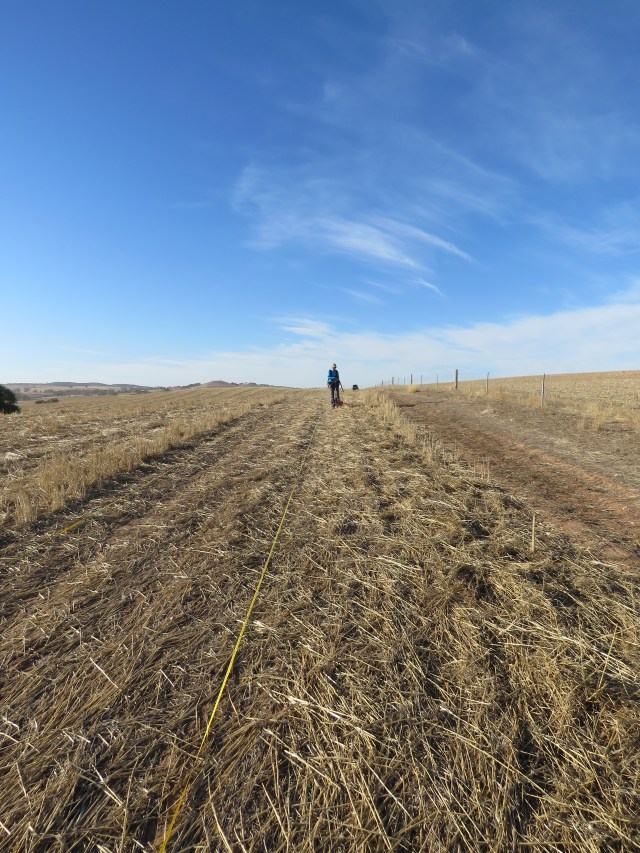
001

Dawn over Baker’s Flat, March 2016

The picture below shows the first line we recorded.  Kelsey’s starting the ground penetrating radar, and we’re all feeling bright and chirpy.

006

Using the GPR on the first gridline

Four days later, we’re not so bright and chirpy. It’s very very hot and dusty, the sun reflects off the wheat stubble making it even hotter, we’re each averaging more than 23,000 steps a day whilst pulling machinery or dragging ropes. Archaeology – it’s not a glamour sport.

019

Here I am, pulling the GPR, hot, determined, not glamorous. Photo: Kelsey Lowe

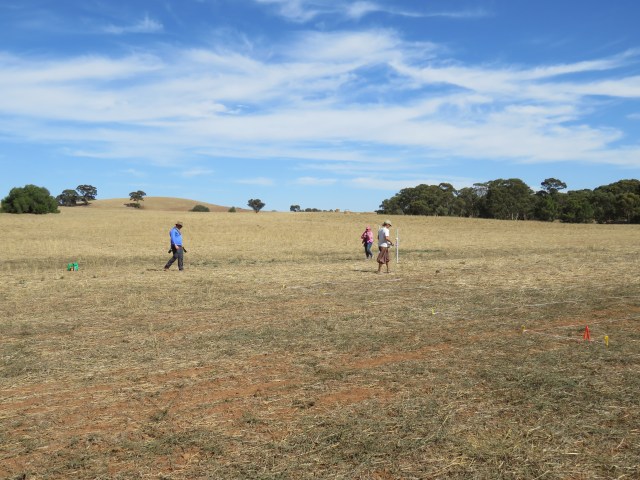
We covered an enormous amount of ground. We worked in 20 metre square grids, constantly moving ropelines which allowed us to walk the grid at even 1 metre intervals. By the last day, we had recorded most of a 240 metre x 100 metre grid. It doesn’t take long to write that but it took a week to do it!

022

Kelsey operating the magnetic gradiometer while Jordan and Lynley move ropelines

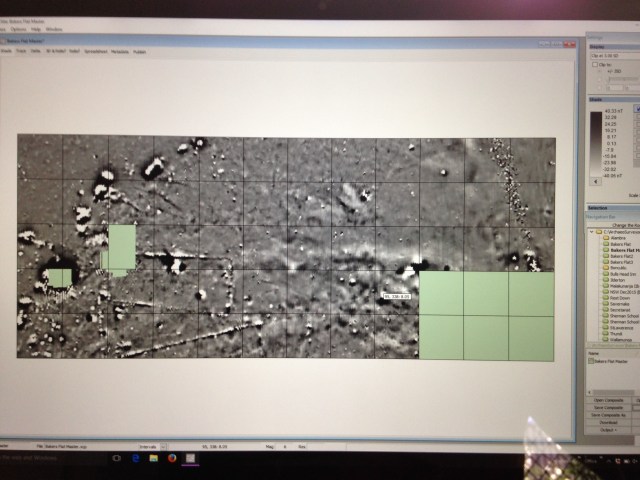
And here’s the glamour bit – downloading the data at night and finding great results. The picture below shows the initial results from the magnetic gradiometer. You can ignore the green squares – they’re the bits we didn’t do, such as the large pepper tree we just couldn’t get through, and the six grids at the bottom right that we didn’t survey. Instead, cast your eyes to those beautiful straight lines near the bottom of the picture, the ones that are triangular and rectangular in shape. Nature doesn’t create straight lines, so these are made by people. And I think that they may be field enclosures – one of the hallmarks of a clachan (traditional Irish settlement). Above the long green rectangle (in real life, a pepper tree) are clusters of white blobs, which I think  are structures, and I’m hoping that they’re houses. You saw the field in the photos above – there is no indication above ground that these structures lie below. The geophys results in this instance are critical in guiding the excavation strategy for the site.

Second Mag Results Entire Grid 03-03-16

Cool results from the magnetic gradiometer

And finally, huge thanks to the fabulous and gracious Kelsey Lowe, Lynley Wallis and Jordan Ralph for donating their time and considerable expertise to work in extreme conditions with me on Baker’s Flat, in the interests of archaeology and science. All they got in return were the last drops of a bottle of gin, blisters, and my gratitude.

Posted in Baker's Flat, Field work, Geophys, Kapunda | Tagged , , , , , , , , , , | Comments Off on Geophys at dawn

100 words a day in Lent, and a potato ritual

During Lent, my micro-challenge to myself is to write 100 words a day on my thesis, with a target of 4000 words by Holy Thursday. I’ve set down some rules. First, the word count is cumulative, so if I do 500 words in one day, it gets me ahead for the days I can’t get to my thesis. Second, the words I write for forms – risk assessments, field trips, excavation permits, equipment lists – don’t count. Third, blog posts don’t count either (a shame, because this one would give me an extra 329). And fourth, since Sundays don’t count in Lent, I don’t have to write on a Sunday.

I think if I had been to kindy and school in Australia, I would have liked the star charts. I do love ticking things off a list. So, I’ve created my own chart for the 100 words challenge, and a traffic light system where I get green if I’ve achieved the target for the week, orange if I’m on track, and red if I haven’t got close. You can see how I’ve done so far in the picture below.

100 words a day in Lent

100 words a day in Lent

Of course, before I can write, I also need to read. And the most poignant thing I’ve read in the past couple of days is about a ritual known as ‘potatoes and point’, described in a 1999 article by Claudia Kinmonth. In the old days, when the Irish were poor and constantly facing the threat of famine, families often shared the meal of potatoes around a communal basket known as a skib. While they sat around the skib, eating pounds and pounds of potatoes, with maybe a bit of buttermilk to wash it down if they were lucky, they would look up to the rafters and point longingly at the side of bacon curing there, knowing that at Christmas or Easter they would be able to add that bacon to the potatoes. Maybe that’s why we love bacon so much in Ireland.

Reference
Kinmonth, C. 1999 Survival: Irish material culture and material economy. Folk Life 38(1): 32-41.

Posted in Folk traditions, Ireland, Writing | Tagged , , , , , , , | 2 Comments

Grand challenges of my archaeology

Earlier this month, Doug Rocks-Macqueen at Doug’s Archaeology invited me to write about the grand challenges of my archaeology as part of his January blog carnival. Thanks Doug, I thought it was a great idea, but then I read some of the other responses written by people like Dr SpaceJunk and Michael E Smith, and got scared off at their eruditeness, academic prowess and ability to stay on task. And now it is 31 January, and the last day of the carnival, and I thought to myself, stuff it, I’ll do it anyway.

So this is a very personal take on the concept of grand challenges, where I’ve chosen to reinterpret ‘grand’ to suit my own purposes. When I’m in Ireland,  and I ask people how they are, a common response is ‘Grand’. I say it myself after I’ve been home for more than a day. And I’m not the only one: ‘Grand’ is used very widely in Hiberno-English according to Dolan (2012:121) to indicate a general sense of wellbeing. I’ll give you some examples:

Q. How’re ya? A. I’m grand.
Q. And the kids? A. Ah, they’re grand too.
Q. Your mam and dad? A. Grand altogether.

It can also be used to convey the meaning that something is good enough, that it will do, as in ‘Fuck it, sure it’s grand’. This is even available on t-shirts and as framed prints – see Jam Art Prints for example.

Fuck It Sure It's Grand.

And it’s a hopeful word. Every year, in the dark days following the winter solstice, almost every single Irish person says at some point, ‘Isn’t there a grand stretch in the evenings’, even though in reality the post-solstice days only increase the daylight in increments of about 47 seconds or thereabouts.

So … it’s a word that oils the social wheels, but also establishes the start of a conversation, allowing deeper questions to evolve. It’s a word that can be used to temper the realities of life, where a finished PhD that’s good enough is better than an unfinished one that’s lying in a drawer. It’s a word that can inject hope for the future. And if I take a very long bow, I can apply all of that to the grand challenges of archaeology research.

Edited on 3 Feb 2016: The complete range of blog posts is now available at Doug’s Archaeology blog – a diverse and interesting selection.

References
Dolan, T.P. 2012 A Dictionary of Hiberno-English: The Irish Use of English. Dublin: Gill and Macmillan.

Posted in Uncategorized | Tagged , , , | 3 Comments