Raggy tree in Riga? Maybe, maybe not

I’ve been in Riga in Latvia for a few days, enjoying the Baltic sun. And on the first evening, in a park near the Freedom Monument, I came across a tree decorated with ribbons.

Tree decorated with ribbons, Riga, June 2015

Tree decorated with ribbons, Riga, June 2015

Although I immediately jumped to the conclusion that this was a Baltic example of a raggy tree, in reality, I think it was just part of an informal celebration held that day. Especially since there were a group of people cutting off ribbons from another branch at the time, and it all looked very organised.

However, two days later, several suns appeared on the same tree. It turns out that the canal banks of Riga near the Freedom Monument are prime spots for the midsummer solstice celebrations coming up any day now. And the tree is an oak tree, one of the Nobles of the Wood.

Latvian suns by the canal in Riga

Latvian suns by the canal in Riga, June 2015

My extensive research carried out on the internet, over at least 15 minutes, has found nothing about a tradition of fairy or raggy trees in Riga. But it is intriguing. So for now, I shall just say that maybe this is a folk practice, and maybe it’s not.

Posted in Around the world, Fairy trees, Folk traditions, Folklore | Tagged , , , , , , , | Comments Off on Raggy tree in Riga? Maybe, maybe not

Raggy trees, an Irish pishogue

A pishogue, in the Irish tradition, is a charm or superstitious practice. And there are many associated with trees, including raggy trees, adorned with physical proof of enduring traditions. Here are just two of them, one at Fore, County Westmeath, and the other at Carraroe, County Sligo.

The Seven Wonders of Fore are well worth a visit, even just for the raggy tree shown below, hung with rags, bits of cloth, watches and plastic bags, resonant of visitors’ wishes and prayers for health, love, exam results, job prospects and good fortune in all the areas of life which remain to some degree out of our control, and therefore susceptible to a handy good luck charm or protective practice.

The tree is an ash, traditionally associated with fertility and healing, especially when linked with water, often in the form of holy wells. This tree is known locally as the Tree That Will Not Burn. It is also called the money tree, because of the coins that have been hammered into its trunk for centuries by pilgrims and visitors. The ash tree sits above St Feichin’s holy well (The Water That Will Never Boil) where sick children used to be immersed to receive a cure.

Raggy ash tree, Fore, Co. Westmeath

Rags attached to ash tree at Fore, Co. Westmeath, December 2010

Coins in ash tree

Coins, old and new, in the bark of the money tree at Fore, Co. Westmeath, December 2010

The Holy Well – An Tobar nAlt – at Carraroe predates the arrival of Christianity in Ireland, and is still a place of quiet reflection. Holly trees at the site are garlanded with rags, bits of cloth, rosary beads, holy medals and scapulars – material proof of prayers and wishes. The holly tree is a symbol of strength, protection, magical power and purification. Although the trees are cleared of their embellishments from time to time, this tradition is very persistent, and the rags and medals are always replaced before long.

Holly tree at the holy well, Carraroe, Sligo

Holly tree at the holy well, Carraroe, Sligo, December 2013


Posted in Around the world, Fairy trees, Flora, Folklore, Ireland, Travelling | Tagged , , , , , , , , , , , , | Comments Off on Raggy trees, an Irish pishogue

It’s a dirty job

This week, Flinders University Archaeology Department is running a field school in the Sturt Gorge, excavating the ruins of a nineteenth century cottage.  The Sturt Gorge Recreation Park covers almost 250 hectares, is just 13km south of Adelaide city centre, and conveniently close to the university. The field school is being carried out in conjunction with Friends of Sturt Gorge.

The rain came in today, and stopped play by mid-afternoon. Until then, we kept smiling and sieving, digging and measuring.

I'm sieving in the rain

I’m sieving in the rain

Trench F has a fine selection of animal bones.

Animal bones in Trench F

Animal bones in Trench F

The picture below is not Trench F, but this may be what it looks like tomorrow morning, since it has now been raining for ten hours non-stop.

Rain on Magpie Creek

Rain on Magpie Creek

The cottage was built on the rise above Magpie Creek.

Magpie Creek

Magpie Creek

Posted in Excavation | Tagged , , , , , , | 1 Comment

Come on you boys in green

Given the continuing success of the Irish team in the 2015 Cricket World Cup, it seems timely to look at cricket in the old days.

In Ireland, for a period in the nineteenth century, cricket was the most widely played sport in the country. In the 1860s there were cricket clubs in every county, and cricket was played by all classes. Although Siggins (2005:26) maintains that cricket in rural areas was largely under the patronage of landlords, Hunt (2004:28-29) disagrees that it was an elite-sponsored sport, and argues that players were ‘essentially young, single and Catholic’ from local villages and parishes, with cricket providing working people with their primary opportunity to participate in sport.

After the Famine, many emigrants took the game to their new homes, and it seems reasonable to assume that the Irish arriving at Baker’s Flat would have had some knowledge of it. Indeed, in the collection of metal artefacts from Baker’s Flat, there are 13 sporting buckles, 12 of which are for cricket – two are shown in the images below.

Cricket buckle depicting two cricketers mid-play

Cricket buckle depicting two cricketers mid-play

Cricket buckle depicting a cricket team and the words WE ARE READY OUR CLUB

Cricket buckle depicting a cricket team and the words WE ARE READY OUR CLUB

Sport played a central role in South Australian colonial country towns. Sporting clubs offered social prestige and strengthened the sense of community. The team sports of cricket and football cut across boundaries of class, ethnic origin and religion, with the cricket field being noted as a place where classes could interact and ‘feel themselves equal’ (Kapunda Herald and Northern Intelligencer 1869:2).

The cost of cricket equipment was quite reasonable, the amount of equipment required was minimal and it could all be communally owned, further reducing the cost. Just as cricket in Ireland offered players from poorer backgrounds an opportunity to display their skills and earn prestige, cricket on Baker’s Flat may have done the same. Interestingly, there was only one ‘national’ team in Kapunda, and this was the Hibernian Cricket Club. So, the playing of cricket may have operated at different levels – in one sense, it helped to cut across ethnic, religious and class boundaries, and in another, its Hibernian associations would have worked to maintain ethnic boundaries.

So, come on you boys in green, and let’s hope that when Ireland play Pakistan on 15 March at the Adelaide Oval, they make their way into the quarter finals.

Bibliography
Daly, J.A. 1982 Elysian Fields: Sport, Class and Community in Colonial South Australia 1836-1890. Adelaide: J.A. Daly.

Hunt, T. 2004 Classless cricket? Westmeath 1880-1905. History Ireland 12(2):26-30.

Kapunda Herald and Northern Intelligencer 1869 The revised estimates. 8 October, p.2. Retrieved 11 March 2015 from http://trove.nla.gov.au/ndp/del/article/108265888.

Siggins, G. 2005 Green Days: Cricket in Ireland 1792-2005. Stroud: Nonsuch Publishing.

Posted in Baker's Flat, Ireland, Kapunda, Migration, South Australia | Tagged , , , , , , , , | Comments Off on Come on you boys in green

Archaeological curiosities in Finland

In Finland recently for a few days, I spent a very happy morning in Aboa Vetus in Turku, Finland’s only archaeological museum. From what I can gather (I have barely a word of Finnish), the museum was a bit of an accident. A contemporary art gallery was planned for the site, and when they started to dig the foundations, a mediaeval quarter emerged. The site is close to Turku Cathedral, centre of activities in mediaeval times.

Turku Cathedral in the snow, Turku, Finland

Turku Cathedral in the snow, Turku, Finland

Now, in other countries, they might just destroy the site by following the original plan and building over it (Woodquay, anybody?), but the Finns excavated it and turned it into an underground museum, along with the contemporary art gallery overground.  They removed 10,000 cubic metres of soil, found more than 37,000 artefacts and 800 kilos of bones, and the remains  of 18 stone buildings, six from the Middle Ages. The archaeological excavations are ongoing, with the dig continuing this summer – which strikes me as a very pleasant way to excavate in a Nordic country – in temperature-controlled environment, with a coffee shop just a flight of stairs away.

Part of the excavated street

Part of the excavated street

To add to my enjoyment, there’s even a dead pig. Buried in the cellars, archaeologists found the skeletons of three dogs, two cats and a kitten, one sheep, two pigs and several piglets, all buried whole. The skeleton shown in the photo below is of a two year old boar, which was found alongside a smaller pig skeleton. Some wild animals, such as rats and frogs, were also found. Now, I am no expert on the archaeology of Finland, but it did strike me as peculiar that such skeletons were found buried in the cellars, and I wonder if this is possibly evidence of a protective, superstitious practice, as found in other parts of Europe, North America and Australia?

Skeleton of a young boar, found buried in the cellars

Skeleton of a young boar, found buried in the cellars

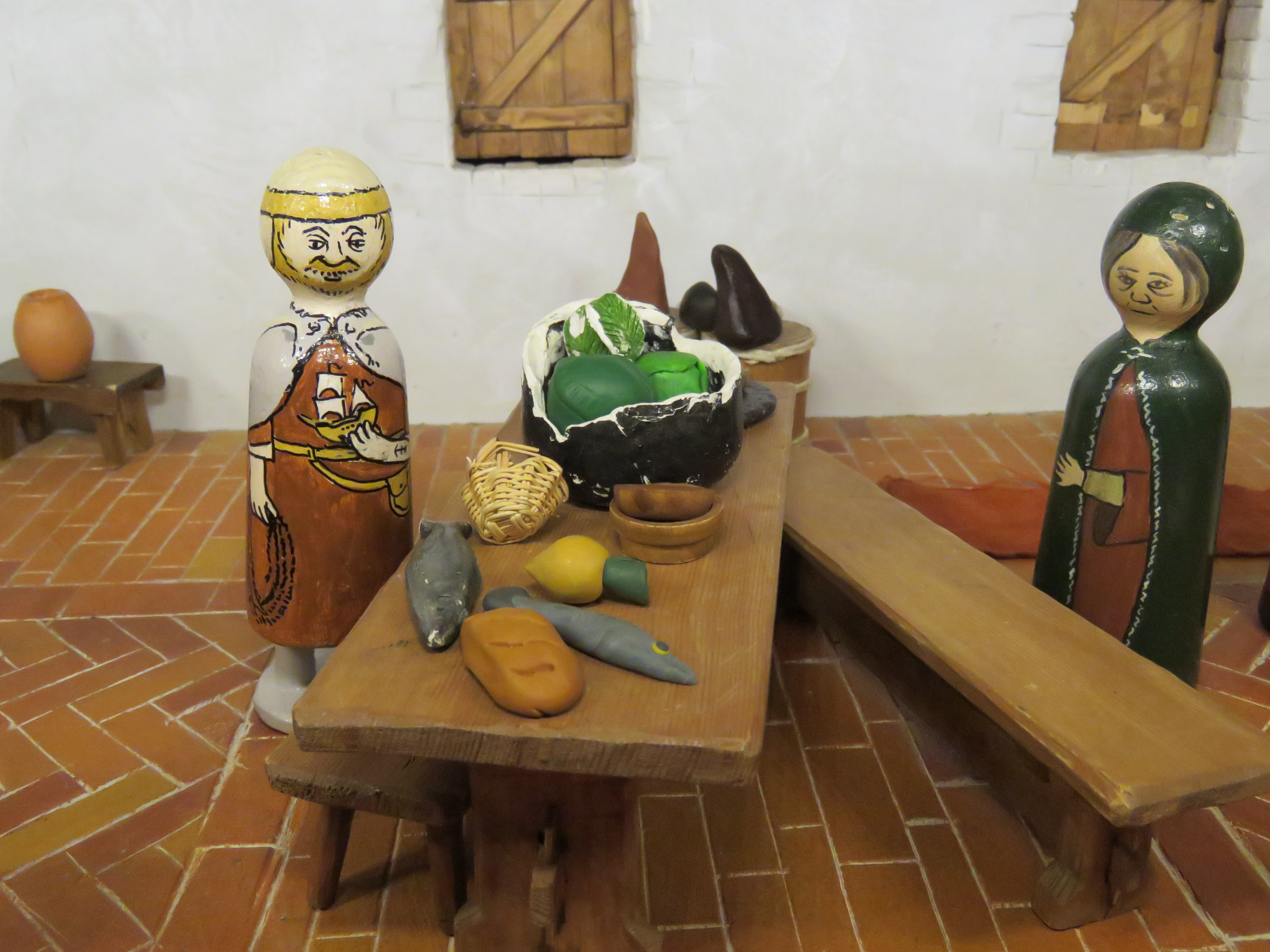
I was also very taken with the model of a mediaeval house, complete with hundreds of wooden figurines and household objects. There were no children to compete with that day, so I had it to myself – photo of one of my tableaus below.

Detail from a model mediaeval house, Aboa Vetus

Detail from a model mediaeval house, Aboa Vetus

Posted in Around the world, Excavation, Folk traditions, Museums, Travelling | Tagged , , , , , , , , , , , | 1 Comment